BY DAVID ADUGE-ANI
The Federal Government, through the Federal Ministry of Health and Social Welfare, has reaffirmed its commitment to transforming Nigeria’s food safety system through a robust, science-driven strategy.
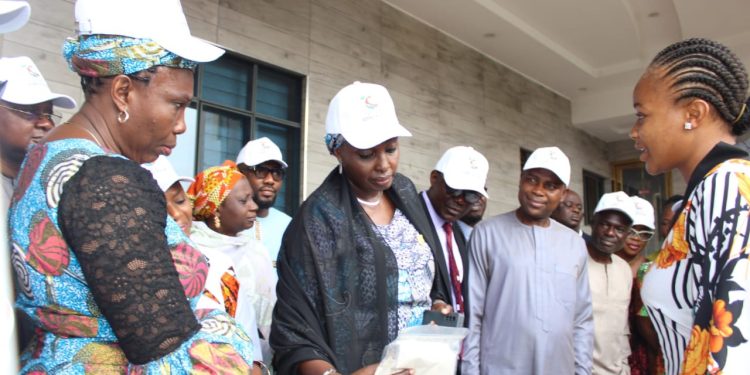
This was revealed by the Permanent Secretary of the Federal Ministry of Health and Social Welfare, Daju Kachollom, in a keynote address during the 2025 World Food Safety Day celebration in Abuja.
The statement was contained in a release signed by Alaba Balogun, Deputy Director, Information and Public Relations.
Speaking under this year’s theme, “Food Safety: Science in Action,” Kachollom declared a new era of evidence-based food safety policy in Nigeria.
She expressed “determined optimism” and emphasised that science must no longer remain on the fringes of policy development, but should form the foundation upon which all regulatory and safety interventions are built.
“By harnessing cutting-edge research, risk assessment methodologies, and foodborne disease surveillance, we are building a resilient system that anticipates threats before they arise,” Kachollom stated.
“This is not mere rhetoric. It is our blueprint for ensuring that every meal in Nigeria is safe, healthy, and trustworthy.”
Continuing, the Permanent Secretary highlighted several milestone policies spearheaded by the Ministry, including the revised National Policy on Food Safety and Quality, the National Guideline for Sodium Reduction, and the National Guideline for Food Handlers’ Medical Test. She noted that these policies have already begun to reshape food industry practices and public health outcomes.
The Permanent Secretary gave special attention to the Ministry’s newly activated Technical Working Groups (TWGs), which she described as “the engine rooms of Nigeria’s food safety future.” These TWGs are working across critical focus areas including risk-based regulation, traceability, food inspection, and science-based education, to provide technical recommendations grounded in validated research.
“Every decision moving forward will be driven by data, peer-reviewed science, and verified field studies. This is how we’ll pre-empt food safety risks and not merely react to crises,” she said.
Looking ahead, Kachollom revealed the Ministry’s plans to invest in specialised training programmes for regulators and food safety professionals across Nigeria.
“We are building a new generation of experts, scientifically equipped, technically sound, and deeply committed to safeguarding public health,” she declared.
Kachollom stressed that the country’s food safety framework must evolve continuously to address both emerging risks and the technological advancements reshaping global food systems.
In a stirring call to action, she charged all pillars of Nigeria’s food ecosystem to embrace their roles in the transformation: Researchers must drive innovation in surveillance tools and risk modelling; Academic institutions must nurture food safety experts through multidisciplinary training; The food industry must invest in technologies that combine safety with nutrition; Regulators must stay ahead by adapting policies in line with new scientific evidence.
“United in purpose and driven by science, we can forge a food safety landscape that is future-ready, resilient, and inclusive,” she said.