

BY GLORIA AKUDORO
The Nigerian Independent System Operator (NISO) has reaffirmed its commitment to achieving its mandate through efficient and transparent management of Nigeria’s electricity grid to drive socio-economic growth.
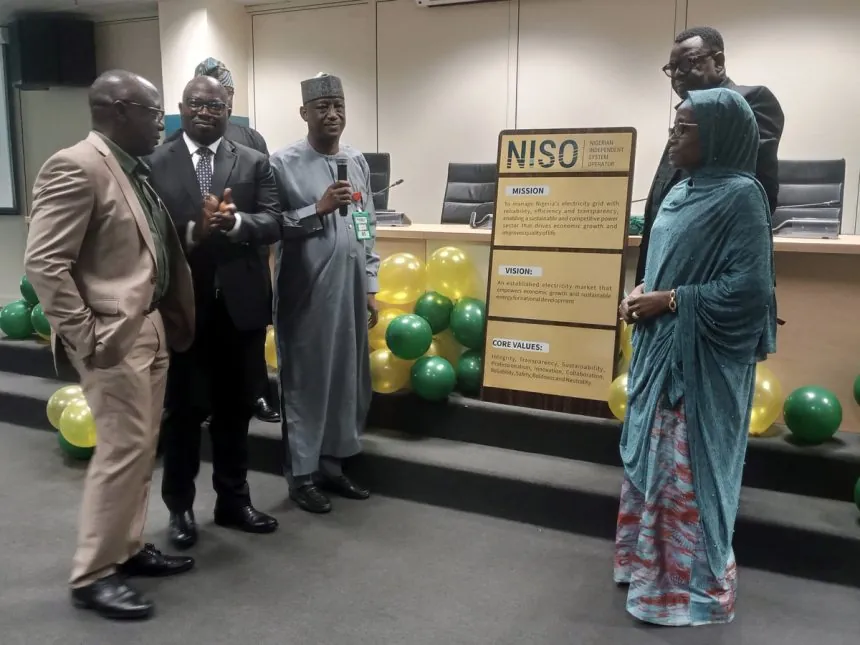
The Managing Director/CEO of NISO, Engr. Abdu Bello Mohammed stated this during the unveiling of the NISO logo on Tuesday in Abuja.
The Nigerian Independent System Operator (NISO) is established in line with the provisions of the Electricity Act, 2023 and pursuant to the Order of the Nigerian Electricity Regulatory Commission (NERC) to operate as an impartial and independent entity responsible for the system and market operation functions within the Nigerian Electricity Supply Industry (NESI).
The unveiling of the Logo ceremony followed an official visit to NISO by the Secretary General of the West African Power Pool (WAPP), Mr. Abdoulaye Dia, where Engr. Mohammed outlined key expectations from WAPP, including enhanced knowledge exchange, increased investor confidence through Public-Private Partnerships (PPP), and improved system reliability.
During the unveiling, NISO MD said: “Our logo represents energy flow, and balance. It reflects structure. It reflects motion. And above all, it reflects control. The kind of control a system operator must maintain over an increasingly complex power system.
“Our mission is clear and unambiguous; to manage Nigeria’s electricity grid with reliability, efficiency and transparency, enabling a sustainable and competitive power sector that drives economic growth and improves quality of life.”
Engr. Mohammed disclosed that NISO has commenced the digitization of the electricity supply system, stating that Nigeria is synchronising its electricity system with the West Africa Power Pool (WAPP). He mentioned that Nigeria was one of the countries that initiated WAPP, while other countries had left it behind.
According to him, NISO did not emerge from thin air. It was born out of reform mandated by law and driven by a national imperative for transparency, neutrality, and reliability in grid operations and electricity market coordination.
“The Electricity Act 2023, which repealed the Electric Power Sector Reform Act (EPSRA) of 2005, did not just change the rules, it changed the structure. And in that structure, Nigerian Electricity Regulatory Commission (NERC) took a bold and necessary step to ring-fence the Independent System Operator (ISO) functions from Transmission Company of Nigeria (TCN) and birth a fully independent system operator. A system operator with a name, a face, and a mission of its own” he said.
Speaking on engaging stakeholders for further direction, Engr. Mohammed stated, “We are engaging stakeholders with a fresh posture. We are no longer an appendage; we are a principal actor and we now sit at the table with the authority of our mandate and the clarity of our purpose.
“We intend to deepen our participation globally, with partners like the West African Power Pool (WAPP) where we contribute not just as observers, but as allies in regional electricity planning. Our site engagements especially of the Supervisory Control and Data Acquisition (SCADA) project and the level of completion with site inspections of Gwagwalada and Katampe substations reflect a management team that is not content with boardroom assumptions; we go and see for ourselves.
“We have commenced the digitisation and automation initiative, in partnership with global technology leaders, Huawei. This will give us real-time system visibility, smart data analytics, and modern SCADA infrastructure. Let me put it simply: this is the kind of progress that turns institutions from reactive to proactive.”



