By Joel Ajayi
The outlook of Abuja is changing at a pace rarely seen since the city was conceived as Nigeria’s modern capital.
The Federal Capital Territory (FCT) was created on February 3, 1976, through the Federal Capital Territory Act (Decree No. 6) under the military administration of General Murtala Muhammed. The territory was carved out of parts of the former Kaduna, Kwara, Plateau and Niger states to serve as Nigeria’s new, centrally located capital.
Following years of planning and construction, Abuja officially replaced Lagos as the nation’s capital on December 12, 1991.
Since the inauguration of President Bola Ahmed Tinubu’s administration and the appointment of Barr. Nyesom Wike as Minister of the Federal Capital Territory in 2023, Abuja has witnessed an unprecedented wave of infrastructure development.
Across the FCT, the sounds of heavy machinery have become the soundtrack of an ambitious urban renewal programme. New roads now connect satellite towns, bridges are rising across major corridors, junctions are being expanded, while solar-powered streetlights illuminate highways that were once shrouded in darkness.
Under Wike’s leadership, Abuja has experienced one of its most significant infrastructure transformations in recent years. From the city centre to rural communities, road construction, drainage projects and public facilities have reshaped the landscape.
Yet. beneath this remarkable progress lies a growing menace threatening to undermine these achievements. As government builds, criminals are systematically dismantling public infrastructure.
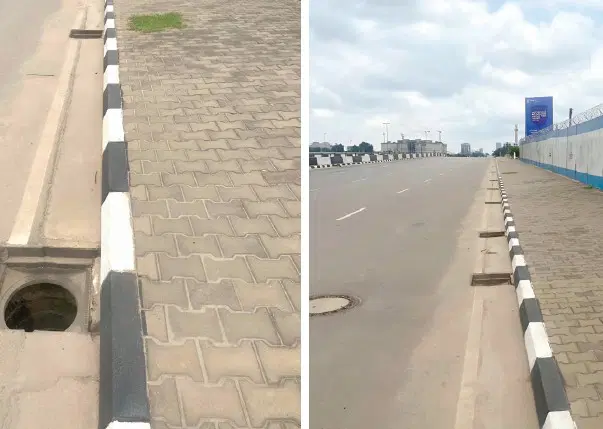
Across Abuja, manhole covers disappear overnight. Solar-powered streetlights are stripped of their batteries and panels. Electrical cables are stolen under the cover of darkness, while road barriers, drainage components and other metallic installations are removed and sold as scrap.
The consequences extend far beyond economic losses – they have become a major public safety concern.
Manholes serve as underground access points for drainage, sewage and utility systems and are normally protected by heavy metal or concrete covers. Once these covers are stolen, they leave deep, dangerous openings capable of causing severe injuries or even death.
Residents say the danger is even greater at night and during heavy rainfall when floodwaters conceal the exposed openings.
Some uncovered manholes across Abuja are estimated to be between four and ten metres deep – large enough to swallow children, adults, pedestrians or unsuspecting motorists.
Investigations by the New National Star found exposed manholes in several busy locations, including the Central Area, Garki, Maitama, Kubwa, Lugbe, Jabi, Utako, Wuse, the Ministry of Power axis, the Transcorp Hilton area and other parts of the city.
In some locations, residents have resorted to placing old tyres, wooden sticks and makeshift barricades around uncovered manholes to warn pedestrians.
A medical practitioner, Dr. Reuben Olatunji, warned that falling into an uncovered manhole can result in multiple fractures, spinal injuries, severe head trauma or even death.
“A fall into an open manhole can result in serious fractures, concussion or even death. The severity depends on the point of impact. The injuries can leave victims with lifelong pain and permanent scars,” he said.
For many residents, these dangers have become painful realities. Oyinye Okonkwo, a provision trader at Wuse Market, recalled how she narrowly escaped tragedy after stepping into an uncovered drainage opening in Jabi while alighting from a commercial vehicle.
“My leg went straight into the hole. Thankfully, people nearby rushed to help me. I escaped with bruises, but it could have been much worse,” she said.
For Samuel Agbana, a civil servant with the Federal Ministry of Water Resources, the consequences were far more devastating.
Two years ago, he fell into an uncovered manhole near Old Airport Junction, suffering severe leg injuries that have kept him away from work ever since.
“My life changed because of one stolen manhole cover. I couldn’t work, couldn’t earn an income and, even after two years, I have not been able to resume work. I am still living with the pain,” he lamented.
Another resident, Donald Albert, also suffered a broken leg after falling into an uncovered manhole in the Central Area.
“Manhole covers are frequently stolen in parts of Abuja, especially within the Central Business District.
“Last year, I unknowingly stepped into one and broke my leg. Imagine what could happen to someone walking there at night,” he said.
In Kubwa, Ifeoma recounted another narrow escape. “I was lucky. My phone slipped into the manhole, but I managed to keep my balance. It was a frightening experience.”
There have also been reports of pregnant women, elderly residents and motorists sustaining injuries or suffering vehicle damage after encountering uncovered drainage systems across the city.
Ironically, while the Federal Capital Territory Administration is investing billions of naira in roads, bridges, drainage systems and solar-powered streetlights, vandals continue to destroy the same infrastructure.
Streetlights installed only months earlier disappear overnight. Solar panels are removed, electrical cables are cut, and manhole covers are stolen for sale as scrap metal.
These acts increase maintenance costs, waste public funds, delay development projects and expose innocent residents to unnecessary danger.
The theft of cast-iron manhole covers has become particularly attractive because of their high value in the scrap metal market.
In response, the Federal Capital Territory Administration has intensified efforts to combat infrastructure vandalism.
The New National Star recently reported that security operations across Kabusa, Mabushi, Wuse and Garki led to the arrest of more than 50 suspected vandals. Authorities recovered stolen manhole covers, solar streetlight components, vehicles and other equipment allegedly used in carrying out the crimes.
FCT Minister Nyesom Wike has described the destruction of public infrastructure as economic sabotage and vowed that perpetrators will face the full weight of the law.
Recent FCT Police reports further revealed that more than 50 suspects were arrested across various “panteka” hotspots in areas like Kabusa, Garki, Mabushi, and Wuse.
Similarly, the Nigeria Security and Civil Defence Corps (NSCDC) FCT Command’s Critical National Assets and Infrastructure Tactical Squad recently arrested 14 suspected vandals during Salah patrols and surveillance operations across different parts of the capital.
The Commandant of the NSCDC FCT Command, Olusola Odumosu, said the command had intensified 24-hour surveillance to protect critical public infrastructure.
Experts, however, believe that arrests alone will not solve the problem.
They recommend stricter regulation of scrap metal dealers, compulsory registration of scavengers, installation of CCTV cameras around critical infrastructure and the replacement of cast-iron manhole covers with composite materials that have little or no resale value.
They also advocate stronger community policing and sustained public awareness campaigns to encourage residents to report suspicious activities.
National Secretary of the Sports Writers Association of Nigeria (SWAN), Ikenna Okonkwo, said protecting public infrastructure requires collective responsibility.
“As Abuja continues its transformation into a modern capital city, safeguarding public infrastructure has become everyone’s responsibility.
“Every stolen manhole cover, vandalised streetlight and destroyed solar installation not only wastes public resources but also endangers lives and slows national development.
“Protecting these investments will ensure that the benefits of Abuja’s ongoing infrastructure renewal are preserved for future generations rather than becoming victims of criminal greed,” he said.
As Abuja confronts the growing menace of infrastructure vandalism, a united effort involving government, security agencies, community leaders and residents will be essential to safeguard the city’s investments.
The message is unique: protecting public property is not the responsibility of government alone. It is a civic duty that every resident must embrace to preserve Abuja’s transformation and ensure that public infrastructure continues to serve present and future generations.