

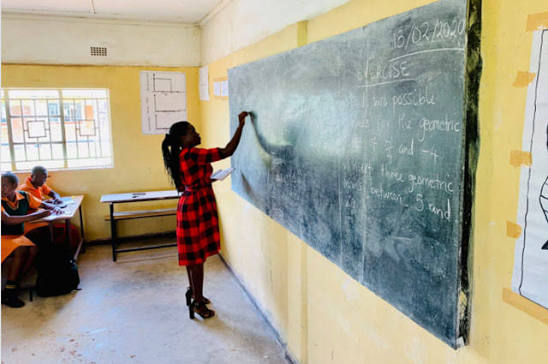
The decision by the Universal Basic Education Commission (UBEC) to deploy technology to tackle teacher absenteeism in public schools is understandable. Persistent teacher absenteeism, lateness and poor commitment to duty can have devastating consequences for the quality of education and the future of Nigerian children.
We do not condone teachers’ absenteeism or habitual lateness. A teacher who repeatedly stays away from the classroom or arrives after pupils have been left unattended is failing in a fundamental responsibility. Teaching is not merely another government job; it is a profession with enormous responsibility for shaping the minds, character and future of the next generation.
However, while technology may help monitor attendance, the government must be careful not to treat absenteeism as though it exists in isolation. If the authorities genuinely want teachers to be punctual, committed and productive, they must also examine the conditions under which teachers work.
There is a growing perception that teachers are among the least appreciated categories of government and private employees. In many parts of the country, teachers contend with poor remuneration, inadequate accommodation, overcrowded classrooms, insufficient teaching materials, stagnated promotion, limited opportunities for professional development and difficult working environments.
These challenges do not justify absenteeism. They do, however, provide important context that policymakers must confront.
A government that demands maximum productivity from teachers must also demonstrate that it values their work.
Teachers occupy a unique position in the society. Before a child becomes a doctor, engineer, lawyer, journalist, scientist, civil servant, entrepreneur or politician, there is usually a teacher somewhere who helped lay the foundation.
Every profession depends on teachers. Yet, paradoxically, the people responsible for producing virtually every other category of professional are often treated as though their contribution is less important.
This attitude must change. Nigeria cannot build a knowledge-based economy while treating teachers as an afterthought. The quality of education is directly connected to the quality, motivation and welfare of teachers.
The government, therefore, deserves commendation for recognising the problem of absenteeism, but the response must be broader.
Technology can tell the government whether a teacher is present. It cannot necessarily tell the government why the teacher is absent.
There is a crucial difference. If a teacher is habitually absent because of indiscipline, that teacher should face appropriate disciplinary measures. Public service cannot function when workers disregard their responsibilities.
But if absenteeism is connected to poor working conditions, inadequate accommodation, transportation difficulties, insecurity or other systemic problems, technology will only identify the symptom without addressing the disease.
This is why UBEC and other education authorities must adopt a balanced approach.
There should be a clear accountability system for teachers, but there should equally be a comprehensive welfare policy.
The government must ask itself whether teachers are being paid salaries that reasonably reflect the importance of their work. It must examine whether teachers have access to safe schools, functional classrooms, teaching aids, toilets, water and other basic facilities.
It must also consider whether teachers posted to rural and remote communities receive adequate incentives.
It is unrealistic to expect a teacher posted to a difficult rural environment to perform under the same conditions as someone working in a well-equipped urban school without considering the additional challenges involved.
Special allowances, housing support and other incentives could encourage teachers to remain in underserved communities.
Nigeria should also strengthen continuous professional development. A teacher who has been employed for decades without adequate opportunities to update his or her knowledge may struggle to respond effectively to the changing demands of education.
The world is changing rapidly. Artificial intelligence, digital learning, new teaching methodologies and evolving approaches to child development are transforming education.
Teachers must be equipped to participate in that transformation.
At the same time, the government should stop allowing the teaching profession to become unattractive to young people.
When the brightest young Nigerians increasingly look elsewhere because teaching is perceived as poorly rewarded, society should be concerned.
A profession responsible for preparing the next generation must attract capable and passionate people.
This requires more than speeches about the importance of education. It requires competitive remuneration, professional recognition and a clear career progression structure.
Digital attendance systems, biometric verification and other tools can improve transparency and provide reliable information about staff attendance.
But such systems should be introduced as part of a broader education management strategy, not simply as surveillance mechanisms.
The ultimate objective should be to improve learning outcomes, not merely to ensure that teachers scan their fingerprints at the right time.
A teacher could be physically present in a classroom and still fail to teach effectively.
Therefore, measuring attendance must go hand in hand with measuring performance, classroom engagement and pupils’ learning outcomes.
Government must also address the wider problem of public apathy towards education.
For too long, education has sometimes been treated as a sector that receives attention only when examinations, strikes or crises generate public pressure. This approach is unsustainable.
If Nigeria wants to compete globally, education must become a permanent national priority.
Teachers should be placed at the centre of that priority. Government cannot demand excellence while providing unacceptable working conditions and then blame teachers alone when the system fails.
The teaching profession must be restored to the position of respect it deserves.
The New National Star urges the Federal, State and Local government to emulate other countries where teachers are treated as critical national assets rather than merely employees on a payroll with paltry sum that discourages interest in the noble profession. Countries that have transformed their education systems did not do so by monitoring attendance alone. They invested in teachers, school infrastructure, curriculum, technology and institutional accountability.
Nigeria must do the same. UBEC’s technology initiative should therefore be welcomed, but it should be regarded as only one component of a much bigger reform.
The real question should not simply be how to catch an absentee teacher. It should be how to create an education system in which committed teachers are properly rewarded, supported and held accountable, while those who consistently fail in their duties are sanctioned.
The government should go beyond checking absenteeism to making the noble profession attractive by recruiting the best brains and prioritising teachers’ welfare.



