

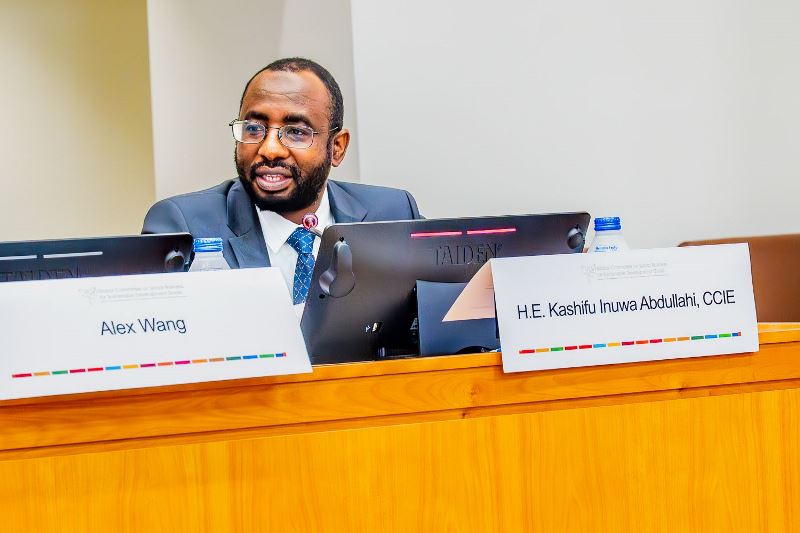
The Director-General of the National Information Technology Development Agency (NITDA), Kashifu Inuwa Abdullahi, has warned that the growing use of artificial intelligence (AI) in cyberattacks is shifting the focus of cybersecurity from protecting digital infrastructure to defending human minds against manipulation.
Abdullahi said cybercriminals were increasingly exploiting human vulnerabilities through AI-generated voices, videos, images and sophisticated social engineering techniques to manipulate what people see, believe, read and think.
He made this disclosure while addressing participants at the second edition of an international cybersecurity conference themed “Cyber Resilience in the Age of AI.”
According to him, the emergence of AI has fundamentally changed the cybersecurity landscape, requiring individuals, organisations and governments to rethink their strategies for detecting and responding to digital threats.
“Hackers focus more on hacking people than systems because it is easier to hack people to get what you want than hacking the system itself,” he said.
The NITDA chief executive warned that the growing sophistication of AI-generated content was making it increasingly difficult to distinguish between authentic information and manipulated material online.
He challenged participants to consider whether society was approaching an era in which people could no longer rely on what they see as evidence of reality.
“Most of us grew up accepting that seeing is believing. But today, maybe I can say 80 to 90 per cent of what we see on the internet is not reality,” he said.
Abdullahi explained that AI could be deployed to create convincing fake audio, videos and photographs, as well as facilitate social engineering attacks capable of deceiving individuals and compromising organisations.
He stressed that protecting people against such threats must become a central component of national cybersecurity strategies, alongside securing digital infrastructure and communication networks.
The NITDA director-general, however, noted that AI was not solely a tool for cybercriminals, adding that organisations could also deploy the technology to strengthen their defences, identify manipulated content and respond more effectively to emerging threats.
He said the ability to recover quickly after a cyberattack was equally important, distinguishing cyber resilience from conventional cybersecurity.
“Cybersecurity is about us defending ourselves from attack, while cyber resilience is about our ability to bounce back after the attack has happened,” he explained.
Abdullahi disclosed that the Federal Government was working with the Office of the National Security Adviser and the National Assembly to review the Cybercrime Act and strengthen the legal framework for addressing emerging cyber threats.
He also said efforts were underway to review existing policies and consider the development of a national cybersecurity architecture that would establish minimum security standards for organisations operating in Nigeria.
According to him, organisations must take greater responsibility for protecting their digital assets, while relevant sectoral cybersecurity structures would continue coordinating with the appropriate national institutions to safeguard the country’s networks.
He emphasised that the security of interconnected systems depended on the strength of every participant, warning that a breach affecting one part of a network could expose other connected individuals, institutions and organisations.
The NITDA chief further highlighted the importance of digital sovereignty, urging Nigeria to strengthen its capacity to control its digital infrastructure, determine its technological future and manage risks associated with dependence on external technologies.
He identified control over data, technology choices, risk-management frameworks and the ability to develop indigenous technological capacity as important elements of digital sovereignty.
Abdullahi said NITDA had issued the National Sovereign Cloud Regulatory Instrument to address issues relating to data, infrastructure, cloud technology and artificial intelligence.
Abdullahi maintained that no country could effectively address cybersecurity challenges in isolation, particularly as AI continued to increase the sophistication and reach of digital attacks.
He expressed hope that the conference would strengthen collaboration among participating countries and produce practical approaches to protecting individuals, networks and national digital infrastructure.
He said the ultimate objective was to build the capacity of Nigeria and other participating countries to withstand cyberattacks, recover from disruptions and retain greater control over their digital futures.
Speaking, Attorney-General of the Federation and Minister of Justice, Prince Lateef Fagbemi, SAN, represented by Director of Public Prosecutions, Mr Rotimi Eseonuwa Oye-Depo, SAN, said Federal Government has commenced work on a draft executive bill to strengthen Nigeria’s legal framework for tackling cybercrime amid growing threats posed by artificial intelligence and increasingly sophisticated digital attacks.
Fagbemi said technological advancement had transformed the nature of cybercrime, making it necessary for Nigeria’s laws, institutions and enforcement mechanisms to evolve to address emerging threats.
He warned that cybercrime had moved beyond isolated online fraud to pose serious risks to financial systems, national security, personal dignity and public trust.



