By Joy Onu
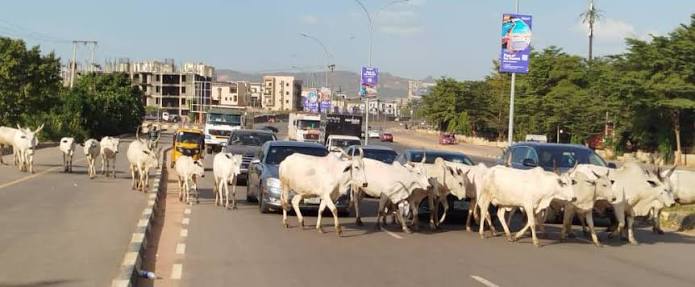
Cattle roaming across major roads in Abuja increasingly frustrate motorists and threaten road safety, highlighting concerns about the Federal Government’s transition from open grazing to organised ranching. From Area 11 and Life Camp Junction to Lugbe and routes leading to Nnamdi Azikiwe International Airport, drivers say they are forced to brake suddenly, change lanes or wait for herds to clear the carriageway.
The recurring sight has fuelled the sarcastic description of the Federal Capital Territory as a “Federal Cattle Territory”, with residents questioning how Nigeria’s capital continues to struggle with cattle on busy roads. Beyond delays, sudden encounters with herds can cause collisions involving vehicles, passengers and animals.
Jane Ado, a Lugbe resident, recalled how cows caused a traffic build-up. On another occasion, while returning home, she encountered a similar situation in which even police officers could do little. Motorists waited until the cattle and their herders slowly moved away before they could continue.
One driver, Ezekiel Momoh, told the New National Star Newspaper that “a lot of motorists have to wait for the cattle to cross”, causing delays on major roads. Yusuf Madaki said cattle sometimes occupy parts of the carriageway and urged the FCT Administration to act decisively.
Businesswoman Aisha Muhammed described the situation as dangerous and embarrassing for the nation’s capital. Muhammed expressed concerns that “every day you see cows crossing the expressway at Berger or Area 1 describing the presence of cattle on Abuja roads as dangerous and embarrassing for a capital city”.
She noted that all the promises made in the past by government officials about putting an end to cattles patrolling the streets have come to nothing.
Cab driver Efosa Gabriel said cattle sometimes block roads completely, leaving motorists stranded for 20 to 30 minutes. He urged the government to demonstrate greater commitment to resolving the problem.
The challenge extends beyond Abuja’s city roads. A November 2026 report on the Kaduna–Abuja highway described gridlock involving cattle trucks, fuel tankers, cargo lorries and passenger vehicles. Drivers also raised concerns about accidents involving long vehicles and animals.
The Federal Ministry of Livestock Development has repeatedly stated that it is pursuing a gradual transition from traditional open grazing to sedentary ranching to reduce long-distance cattle migration and develop a commercially viable livestock sector.
According to the ministry, 273 gazetted grazing reserves covering more than 4.5 million hectares are to be transformed into livestock villages with water, veterinary clinics, pasture and other facilities. Three pilot grazing reserves are also being developed in Abuja to move livestock away from the city centre.
Under the National Ranching Policy, pilot hubs have been identified in Benue, Plateau, Nasarawa, Kaduna, Adamawa and the FCT. Another 417 grazing reserves nationwide are earmarked for rehabilitation into integrated livestock communities. The government is also introducing radio-frequency identification ear tags to establish livestock ownership, location and traceability.
Minister of Livestock Development, Idi Mukhtar Maiha, said long-distance movement is increasingly unsustainable as farming, urbanisation and infrastructure development reduce traditional grazing routes. He argues that designated settlements with feed, water and services would reduce cattle movement through communities and roads.
Maiha says enforcement should follow the provision of adequate facilities. “We are not going to force them,” he said, adding that restrictions would begin once designated areas were equipped and safe for pastoralists, their families and animals.
In Abuja, the ministry says it is working with the FCT Administration, pastoralists and other stakeholders to curb cattle movement through the city centre and rehabilitate grazing reserves. About 33,000 hectares outside the Abuja metropolis but within the FCT have reportedly been reserved for livestock settlements. The ministry also plans to relocate about 30,000 herds from the city centre to the Kawu grazing reserve in Bwari Area Council.
Minister of the FCT, Nyesom Wike has described cattle grazing on Abuja roads as a national-security issue, rather than solely an FCT responsibility. He has also said the federal government is engaging Miyetti Allah and other stakeholders on ranching.
The Nigeria Police Force (NPF) said controlling roaming cattle is not within its primary mandate, placing responsibility on environmental authorities. Police may intervene where animals damage property, trespass or are involved in another offence. The differing positions have exposed an accountability gap among agencies responsible for land use, environmental control, policing, traffic management and livestock policy.
The situation is complicated by the absence of a single nationwide law explicitly prohibiting open grazing. In Abuja, authorities rely on environmental and nuisance-related provisions, including the Abuja Environmental Protection Board Act 1997, which prohibits grazing in nursery sites and the destruction of ornamental plants.
The Abuja Master Plan originally designated grazing areas including Kawu, Rubochi, Paikon Kore and Wassa. Urban expansion has brought roads, homes and commercial developments closer to these spaces and traditional livestock routes, intensifying friction among herders, residents, motorists and property owners.
Government engagement with the Miyetti Allah Cattle Breeders Association of Nigeria (MACBAN) has focused on ranching and compliance with FCT regulations. However, earlier cattle impoundment operations reportedly met resistance from some herders who considered them harassment.
Other countries offer lessons. In India, highway regulations place responsibility on animal handlers. Pilot roadside cattle shelters provide fodder, water, caretakers, veterinary support and cattle ambulances. Tagging, penalties, warning signs and monitoring of high-risk sections are also proposed. Following repeated cattle-related crashes, a Chhattisgarh court called for stronger measures, including holding areas, ear-tagging and owner accountability.
Botswana combines road fencing with livestock-control regulations. Farmers must keep animals off road reserves, and cattle cannot remain on main roads without proper supervision. Fines and liability for damage apply, although damaged fences, poor maintenance and deliberate breaches show that fencing alone cannot guarantee safety.
Kenya recognises the economic importance of pastoral mobility. Mapping has identified about 31,597 kilometres of livestock routes nationwide, with recommendations to protect them and invest in veterinary services, holding grounds and loading ramps. Controlled crossings and underpasses are also considered where highways intersect livestock routes.
For Abuja, the immediate priority should be protecting motorists while implementing longer-term livestock reforms.
The FCT Administration, Livestock Ministry, police, Federal Road Safety Corps (FRSC), Vehicle Inspection Office (VIO) and environmental authorities should establish a joint framework designating major roads, expressways, airport corridors and residential districts as cattle-free zones. Clear rules and warning signs should cover high-risk locations such as Berger, Area 1, Life Camp and airport-bound routes.
A rapid-response team should remove uncontrolled cattle, impound them where necessary and identify their owners. Where crossings are unavoidable, the government should provide supervised crossing points or underpasses away from junctions, blind bends, schools and markets.
Designated routes and crossing times, supported by traffic control, would reduce accidents.
The planned livestock identification system should be implemented to trace owners and ensure accountability where animals obstruct traffic, damage property or cause crashes. A clear incident-response arrangement would also prevent agencies from shifting responsibility.
Meanwhile, grazing reserves and ranches must provide reliable water, pasture, feed storage, veterinary services, security, market access, loading facilities and basic amenities for herder families. Relocation should not be enforced until destinations are safe, accessible and economically viable.
Government should sustain engagement with MACBAN, traditional institutions and local pastoralist leaders, protecting compliant herders from harassment while ensuring that those who negligently endanger road users face consistent consequences.
Ultimately, Abuja must balance motorists’ immediate safety concerns with a fair transition in livestock management. Residents should not have to wait helplessly for cattle to clear busy roads, while pastoralists should not be displaced without viable alternatives.
The Federal government and FCT Administration must move beyond policy announcements and combine effective road-safety enforcement with functional livestock settlements. Until this happens, the description of Abuja as a ‘Federal Cattle Territory’ may continue to resonate with motorists whose daily journeys are disrupted by roaming herds.