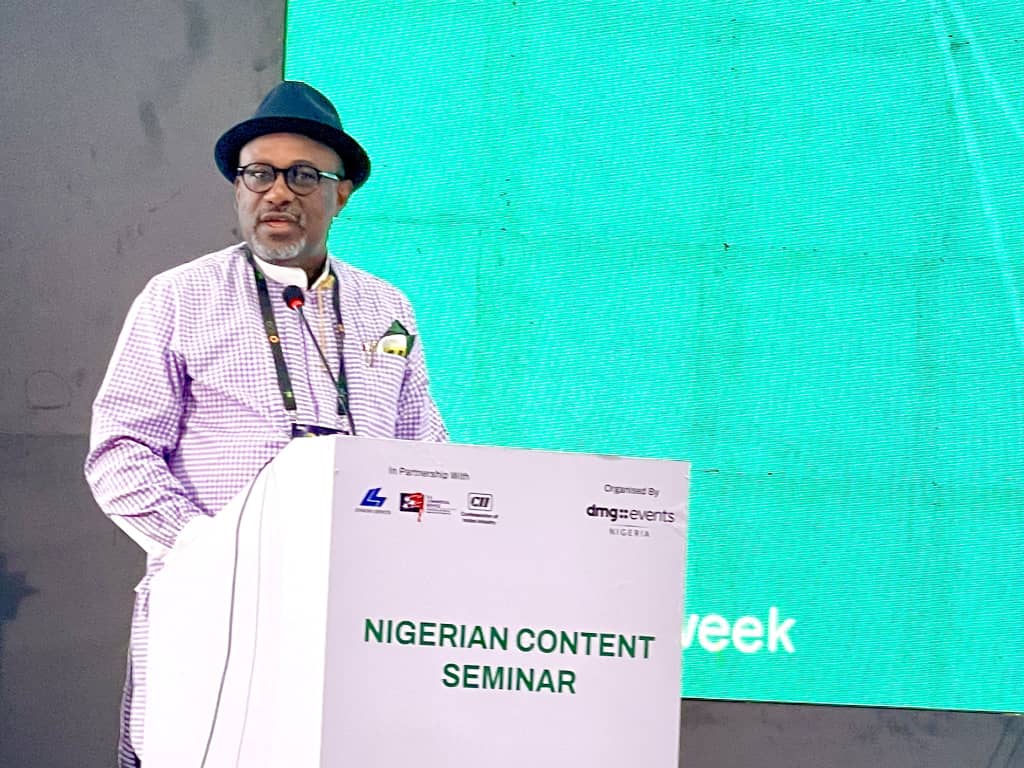
The Executive Secretary, Nigerian Content Development Board (NCDMB), Engr. Simbi Kesiye Wabote on Monday restated the Board’s commitment to ensuring the full implementation of the Nigerian Oil and Gas Industry Content Development (NOGICD) Act of 2010 in order to promote development and utilization of in-country capacities.
This he made known in his opening address at the Nigerian Content Seminar, as part of the opening tradition of the 2023 NOG Energy Week taking place at International Conference Centre with the sub-theme: “Nigerian Content Role in Achieving Energy Security”.
According to him, the seminar is aimed at providing clarity, expositions, tips, and guidance to industry practitioners on the provisions of the NOGICD Act (2010), the ministerial regulations, guidelines, tools and initiatives such as HCD, N-JQS, NC Plan, NCEC, Expatriate Quota, Monitoring, NCDF Remittances, NC Intervention Funds, among others.
“We believe this will provide a good basis to facilitate the understanding of one of the key enactments guiding the oil and gas industry in Nigeria as industry players progress to discuss the various opportunities in the next two days”, said the ES.
Wabote who also stated clearly that in upholding the prescriptions of the Act, the Board have turned down many proposals and requests that are not in line with the NCDMB law while shedding more light on the functions of the Board as stipulated in section 70 of the NOGICD Act that covers up to sixteen (16) activities.
A brief rundown of section 70 of the NOGICD Act of 2010 are as follows:
Section 70(a) mandates the board to implement all the 107 sections contained in the Act; Section 70(b) states implementation of the Ministerial Regulations, of which, seven laws have been gazetted in 2021; Section 70(c) mandates the board to manage the development of Nigerian Content (NC) in the oil and gas industry; Section 70(d) stipulates the supervising, monitoring and administering the development of NC and Section 70(e) mandates the appraisal, evaluation and approval of the NC plans and reports that are submitted to the Board.
Also Section 70(f) mandates the Board to award the Certificate of Authorization (CoA), conduct reviews of the NC plans and reports submitted to the Board; Section 70(g) mandates its to administer and operate the e-Marketplace and Joint Qualification Systems platform as the repository of all industry capacities and capabilities; Section 70(h) mandates its to assist local contractors and Nigerian companies to develop their capabilities and capacities; Section 70(i) stipulates that the Board make procedures to guide the implementation and compliance of the Act and Section 70(j) stipulates its to monitor and coordinate the NC performance of all operators in accordance with the Act.
Others include Section 70(k) which stipulates to make auditing procedures and conduct regular audits for the purposes of monitoring and ensuring compliance with the Act; Section 70(l) mandates the Board to provide guidelines, definitions, and measurements of Nigerian Content and Nigerian Content indicator; Section 70(m) mandates its to conduct studies, research and investigation that may further the attainment of the goal of developing NC; Section 70(n) says the Board should organize conferences, workshops, seminars, symposia, training, roadshows among others; Section 70(o) mandates the Board to delegation functions of any agent or operative appointed by the council and lastly Section 70(p) provides for the Board to make legally anything necessary to be done to facilitate the carrying out of its functions.
However, the panel sessions after the seminar explored on the selected three (3) processes and initiatives of the Board which are Nigerian Content Equipment Certificate (NCEC), Nigerian Content Intervention Funds (NCIFund), and the HCD Guidelines.
Wabote said the objectives are to provide participants with clear views of what is contained in the NOGICD Act and clarity to those who have misconceptions about some of its interventions, and to get feedback on any challenges that are being faced as well as provide guidance on steps to resolve the challenges free of charge.
The ES further underscored the need for NCDMB licensing, stating that “Nigeria is back for business and the rule of law must be obeyed and must be implemented to the latter”.