

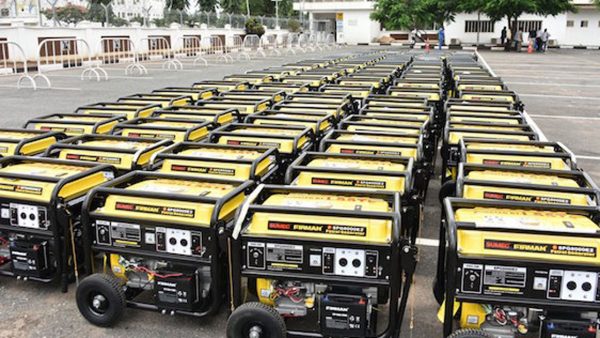
Nigerians resorting to alternative electricity supply due to epileptic grid network spends about $14 billion yearly on generators and petrol, the African Development Bank (AfDB) has disclosed.
The AfDB President Dr. Akinwunmi Adesina, who gave this figure during his lecture titled ‘The Day the Lion Roared! Making Nigeria a Global Industrial and Economic Giant’ at the Business Day Chief Executive Officers’ (CEOs’) Forum at the weekend in Lagos, also said that Nigeria had been losing an average of $29 billion yearly due to power failure.
Citing the International Monetary Fund (IMF) report’s findings to justify his position, the development finance banker said: ‘It has been estimated by the International Monetary Fund (IMF) that Nigeria loses 29 billion dollars annually due to lack of and unreliable power supply or 5.8 per cent of its GDP. ”
”Also, that Nigerians spend 14 billion dollars per year on generators and fuel. Today, capacity utilisation of factories hovers around 40 per cent compared to desired 70 per cent. The reality is that firms are moving to other neighboring countries, where there is greater macroeconomic stability, enabling environment, with better ease of doing business.
”To be a manufacturer in Nigeria is not an easy venture. You succeed not because of ease of doing business, but by surmounting several constraints that limit industrial manufacturing. The major challenge facing the industry in Nigeria is the high cost and unreliability of supply of electricity”, Adesina added.
According to him, the load shedding and unreliable power have made Nigeria’s cost of manufacturing extremely high and uncompetitive as majority of manufacturing entities in the country have to do self-provision on energy, with dependence on generators, diesel and heavy fuel oil.
He further clarified: ”The Manufacturers Association of Nigeria, said industries spend N93.1 billion on alternative energy in 2018. No business can survive in Nigeria without generators.
”Unless Nigeria decisively tackles its energy deficiency and reliability, its industries will remain uncompetitive”, the AfDB chief warned.
On the options open to the country to reverse the ugly trend, Adesina said there should be massive investments in gas to power to ensure stable baseload power for industries, hydropower resources, large scale solar systems and direct power preferentially to industries.
Adesina spoke on the development finance institution’s interventions in the power sector across Sub-Sahara African (SSA) countries and specifically noted that the bank had supported Nigeria’s implementation of the Power Sector Recovery Programme.
He expatiated: “The Bank provided 200 million dollars for the Nigeria Electrification Project, designed to fill the electricity access gap in Nigeria.
”We have also invested 257 million dollars in the Nigeria Transmission project, to strengthen grid power evacuation and regional interconnection. The Bank has inaugurated the Desert to Power initiative, a 20 billion dollar project to provide electricity for 250 million people across 11 countries of the Sahel, including Northern Nigeria.
”This initiative will draw lessons from successful projects already financed by the Bank, including the Noor Ouarzazate solar PV power project in Morocco and the Ben Ban solar project in Egypt”, the AfDB chief added.



