By Gorge Ameh
As political parties fix prices for their 2027 nomination forms beyond the reach of most ordinary citizens, a generation of young, qualified Nigerians is being systematically locked out of the very system they are told to trust. The New National Star examines the numbers, the voices, and the democratic crisis hiding in plain sight.
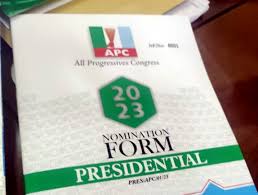
The APC has since fixed the cost of its 2027 presidential nomination form at N100 million, a figure that is nearly twice the total legitimate salary a president earns over four years, and more than a thousand times Nigeria’s monthly minimum wage. Broken down, the presidential aspirants pay N30 million for the Expression of Interest, and N70 million for the nomination form. Governorship aspirants pay a total of N50 million, Senate N20 million, House of Representatives N10 million, and State House of Assembly N6 million respectively.
The PDP faction aligned with FCT Minister, Nyesom Wike, is not far behind. It fixed the cost for its expression of interest and nomination forms for the presidency at N51million, governorship at N31million, and Senate and House of Representatives at N7 million and N4 million respectively.
The All Progressives Grand Alliance also set its prices high as presidential aspirants must pay N75 million: N25 million for the expression of interest and N50 million for the nomination form. Governorship aspirants pay N35 million, Senate N21 million, House of Representatives N16 million and State Assembly N8 million.
Only the African Action Congress charted a meaningfully different course. The party fixed the combined cost of its presidential expression of interest and nomination forms at N2.1 million, N100,000 for the expression of interest and N2 million for the nomination form. Its Governorship and Senate aspirants pay a combined N1.1 million each, House of Representatives aspirants N600,000, and State House of Assembly N250,000. The party is not considered as one with a realistic path to federal power. And therein lies the trap.
To fully grasp the absurdity of the above figures, they must be placed against the economic reality of the country whose leadership these forms supposedly unlock. The Nigerian president earns a total salary package of N1.17 million monthly including a basic salary of N292,892, a hardship allowance of N146,446, and a consistency allowance of N732,230, according to the Revenue Mobilisation Allocation and Fiscal Commission.
A governor on his part earns approximately N7.8 million annually. In other words, he or she would need to save his entire official salary for more than six years to afford the APC’s governorship nomination form.
Now, Nigeria’s national minimum wage stands at N70,000 per month, roughly N840,000 annually.
According to the Nigerian Consumer Outlook Report 2025, less than 1 per cent of Nigerians earn above N1 million monthly, while the majority earns below N100,000 or has no stable income. The World Bank estimates that more than 60 percent of Nigerians live below the national poverty line. For young Nigerians, savings are rare and access to capital is minimal.
Dr. Aysha Abdullahi, a political economist at Bayero University, Kano, opines that the nomination form regime has effectively formalised the commodification of political candidacy. “What these prices do is replace political merit with financial gatekeeping. You no longer ask: is this person qualified, do they have community support, do they have ideas? You ask: do they have N100 million? That is not a democratic process. That is an auction,” she said.
Nigeria has one of the youngest populations in the world, and the numbers make the exclusion of youth from political office both a demographic paradox and a democratic tragedy. Youths make up more than 67 per cent of registered voters, which means that whoever they decide to vote for is sure of winning any election. Yet they wield almost no power within the structures that determine who is placed before them on the ballot.
Despite the passage of the “Not Too Young to Run” bill in 2018 which lowered age requirements for elective office, the number of youths aged 18 to 29 voted into elective positions remains less than 1 per cent.
The data on voter engagement tells a related story of disillusionment. Nigeria’s voter turnout has witnessed a steady decline since its peak in 2003, when turnout reached 69 per cent. In the 2023 elections, turnout was just 27 per cent the lowest in Nigeria’s democratic history.
Young people surveyed on political participation were not indifferent. They followed elections. They argued about candidates on WhatsApp. They cared. But when it came to showing up, registering for a party, attending a rally, or running for office, the barriers were concrete and material.
Transport costs money. Taking time off work costs money. Campaign registration costs money. In a country where youth unemployment is about 50 per cent in some states, these are not small obstacles.
Fatima Usman, a 27-year-old businesswoman in Katsina said she had given up on the idea of ever running for office despite being approached by members of her community to contest her ward councillorship. “They told me to go and buy the form. I said: buy the form with what? I am the one feeding my family. The form costs more than my entire shop. These parties do not want people like us. They want their friends,” she said.
Isah Abdullahi, a 32-year-old constitutional lawyer in Kano was more pointed. “The ‘Not Too Young to Run’ bill reduced age limits but it didn’t reduce the cost of running. Age was never really the problem. The problem was always money. And that problem is worse in 2026 than it has ever been,” he said.
For young people determined enough to try despite the financial barriers, the nomination fee structure drives them directly into a patronage system that further erodes their independence once in office.
The entrenched system of godfatherism creates a gatekeeping mechanism where political opportunities are controlled by influential elites, thereby marginalising youth who lack connections. In exchange for the financial backing needed to purchase a form and fund a campaign, the aspirant surrenders future decision-making autonomy to the patron creating a class of officeholders who are legally elected but practically beholden.
In exchange for funding, loyalty is secured, and future decision-making is shaped long before office is attained.
This dynamic is not limited to national offices. At the local level where youth participation should be most accessible a different form of exclusion takes hold. A former two-term councillor in Kano State who demanded anonymity said he entered politics through a godfather arrangement when he was 26, and disclosed that the debt never went away. “I spent my entire first term doing what my sponsor wanted, not what my constituents needed. He paid for my form, he funded my campaign, and so I belonged to him. That is the system. Young people who enter through that door do not come out as independent voices,” he said with a note of bitterness.
Political parties have consistently defended the high cost of nomination forms on two grounds: inflation and seriousness of purpose. The argument is that only candidates with demonstrated financial capacity whether personal or from supporters are viable contestants worth processing. Party leaders argue that the high cost of nomination forms is a due diligence measure to distinguish pretenders from contenders, a parameter for measuring interest, seriousness, and commitment to contest for office. In the absence of state funding, parties also argue that they need to generate revenue from the sale of forms to fund party activities.
But this reasoning collapses under scrutiny. If inflation were the driving force, the cost of APC presidential forms in 2022 should have been around N100 million based on inflationary calculations from 2015 to 2022. Yet the actual jump in prices far exceeded what inflation alone could explain. Evidently, inflation is not necessarily the driving force behind the sharply increased prices of nomination forms.
Professor Adamu Suleiman, a professor of public administration at the University of Jos, told the New National Star that the inflation defence was “arithmetically dishonest.”
He said: “If you use Nigeria’s own NBS inflation data to calculate the expected rise in form prices from 2015 to today, you do not arrive at N100 million. You arrive at a fraction of that. The parties have used inflation as a rhetorical shield for what is, at its core, a cartel arrangement to preserve access to power among a fixed class of wealthy individuals.”
The insensitivity to the prevailing socio-economic situation makes the candidate selection process susceptible to capture by money bags. As the chairman of Nigeria’s ruling party once noted, “If you don’t have N100 million, you have no business with becoming president.”
The implication is the evolution of a state governed by and for wealthy elites, to the detriment of popular participation.
The APC recently introduced a limited concession for the 2027 cycle. Female aspirants, youth, and physically challenged aspirants are to pay the expression of interest fee in full but receive a 50 per cent discount on the nomination component for each position. For a young person seeking a House of Assembly seat, this reduces the total from N6 million to approximately N3.5 million; the Expression of Interest of N1 million plus half of the N5 million nomination fee. The figure still represents more than three and a half years of unspent minimum wage income. The discount, critics say, is cosmetic. “A 50 per cent discount on a price that was already prohibitive does not solve the problem,” Dr. Abdullahi of Ahmadu Bello University told the New National Star.
“It is optics. It signals awareness without action. What they are saying is: we know young people and women cannot afford this, so we will charge them half of what we know they cannot afford,” he noted.
Zainab Mohammed, a 30-year-old community health worker from Kaduna who had considered running for a House of Representatives seat, said she initially felt hopeful when she heard about the discount. “Then I did the maths. Half of ten million is still five million. I have never seen five million naira in one place in my life. So, the discount means nothing.”