

BY SIMEON OGOEGBULEM
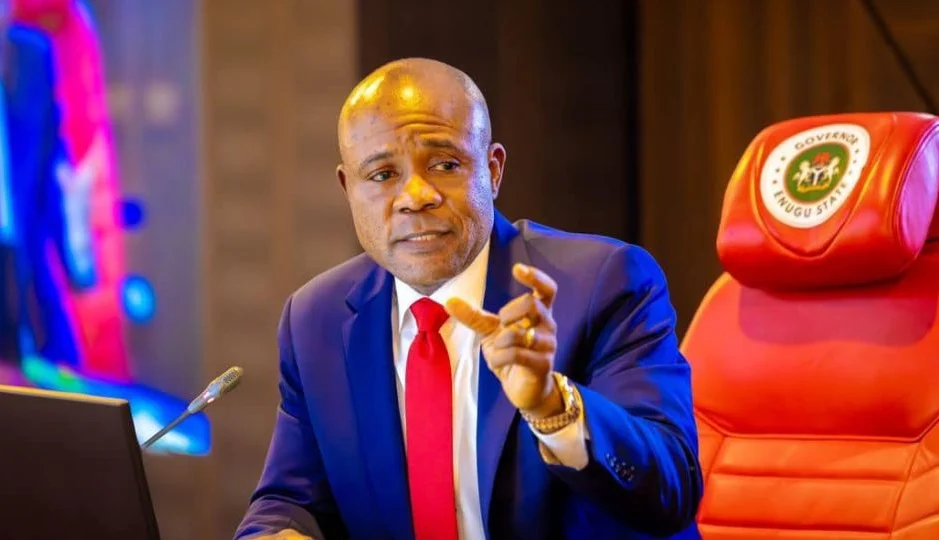
Governor Peter Mbah of Enugu State has approved the allocation of a parcel of land in the state capital, for the establishment of a state-of-the-art Digital Fabrication Centre (DFC) by the Industrial Training Fund (ITF), describing the DFC as timely and consistent with his administration’s vision of making Enugu a leading destination for investment, innovation and technology-driven industrial development.
Mbah who gave the approval when he played host to a delegation of ITF, stated that the future of economic prosperity depends largely on deliberate investments in human capital and emerging technologies, stressing that the state has continued to create an enabling environment for innovation, enterprise and sustainable growth.
He explained that his administration has made technical education compulsory within the state’s basic education system, with emphasis on digital literacy, robotics and mechatronics to prepare young people for the future of work.
According to him, many traditional trades are increasingly being driven by digital technologies, making it necessary to equip young people with relevant technical skills that will enable them to compete globally and contribute meaningfully to economic development.
The governor also disclosed that his administration has established smart schools across the state, equipped with robotics centres, mechatronics laboratories and other modern learning facilities to prepare youths for the changing global economy.
He noted that artificial intelligence is expected to contribute about $20 trillion to the global economy in the coming years. The governor therefore stressed the need for the state to be intentional about upskilling its citizens, noting that the establishment of the ITF Digital Fabrication Centre would strengthen Enugu’s efforts to build a knowledge-based economy, promote innovation, encourage local manufacturing and create employment opportunities for its growing youthful population.
Earlier, the Director-General of the ITF, Dr. Afiz Oluwatoyin Ogun, who led the delegation, said that upon his appointment by President Bola Ahmed Tinubu, he was mandated to upskill Nigerian artisans to international standards.
He explained that the Fund subsequently repositioned its technical and vocational skills development programmes through strategic initiatives, including the Skill-Up Artisans (SUPA) Programme, which is designed to train, certify and licence Nigerian artisans to international standards.
Ogun disclosed that the ITF had already established a Digital Fabrication Centre in Ikeja, Lagos, with the capacity to produce more than 400 different products. He therefore requested the allocation of land in Enugu State for the establishment of a similar centre with the same production capacity.
According to him, the initiative is aimed at promoting industrialisation, reducing dependence on imports and preparing Nigerians for opportunities in the Fourth Industrial Revolution. He also reaffirmed the Fund’s readiness to enter into Public-Private Partnerships (PPPs) that would transform Nigeria’s artisanal ecosystem.
Dr. Ogun further noted that digital technologies, including artificial intelligence, robotics and computer-aided manufacturing, are rapidly transforming the global economy, making it imperative for Nigeria to deliberately invest in workforce development and upskilling to remain globally competitive.
The ITF delegation later embarked on a guided tour of facilities at one of the Smart Schools established by the Enugu State Government.



