By Cyril Ogana Jr
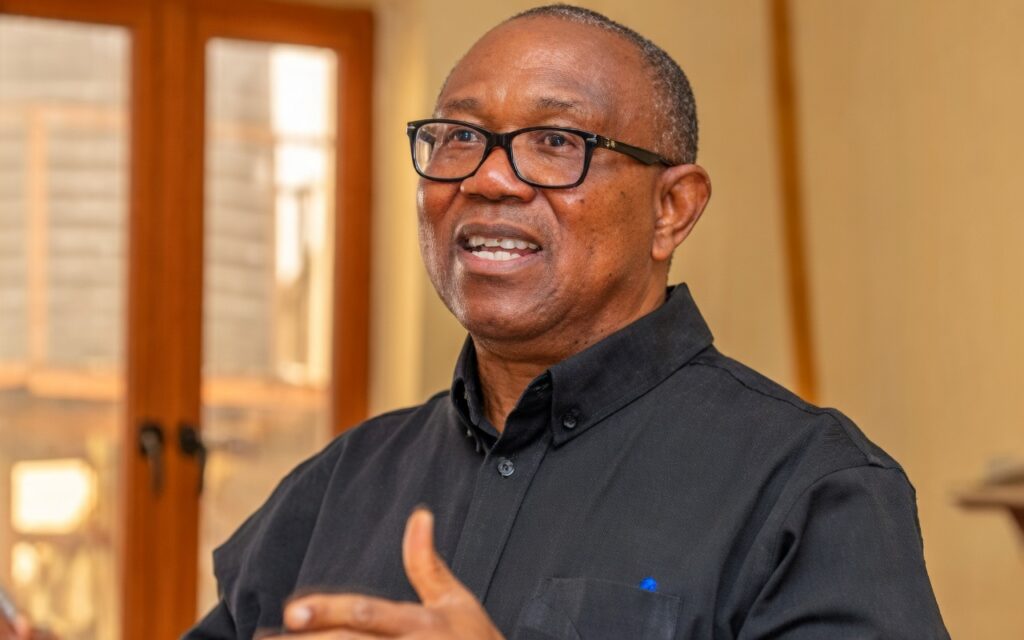
The presidential candidate of the Nigerian Democratic Congress, NDC, Mr. Peter Obi has pledged to increase Nigeria’s electricity generation and distribution capacity by at least 10,000 megawatts, MW, within four years, representing a 250 per cent increase from the country’s current output of about 4,000MW.
Obi made the commitment, while accepting his nomination as the presidential candidate of the Nigerian Democratic Congress, NDC, at the party’s convention in Abuja.
Obi, said Nigeria’s power shortfall continues to cripple businesses, choke industries, and stall overall economic growth.
He said the country currently has the highest number of citizens without access to electricity in the world. “We currently generate and distribute a mere 4,000 megawatts (MW) of electricity for a population exceeding 200 million.”
He said nations such as South Africa and Egypt each generate and distribute more than 40,000MW of electricity despite having populations that are less than half of Nigeria’s.
“Over the next four years, I commit to ensuring a minimum of 10,000 MW power increase generation and distribution,” Obi stated.
Nigeria’s power sector has faced persistent challenges for decades, including inadequate generation capacity, ageing infrastructure, weak transmission networks, mounting debts and chronic inefficiencies.
The national grid suffered multiple collapses in recent years, highlighting the fragility of the country’s electricity system. In January 2026 alone, the grid collapsed twice within five days, while similar incidents were recorded in 2024 and 2025, when the grid reportedly failed at least 12 times.
In a bid to revive the sector, President Bola Ahmed Tinubu recently appointed Joseph Olasunkanmi Tegbe as Minister of Power following the resignation of Adebayo Adelabu, who stepped down to pursue elective office.
The administration also appointed Rilwan Lanre Babalola to lead efforts aimed at restoring stability and improving performance across the electricity value chain.
Recently the African Development Bank (AfDB) confirmed that 70.7 per cent of businesses in Nigeria rely on private power generators to keep running. The data, published in the African Economic Outlook Report, highlights how unreliable public electricity severely impacts local operations.
Frequent power outages and generator use cost Nigerian businesses about 3 per cent of their annual sales. The AfDB notes that households and businesses are forced to privately fund services that the government should provide, ultimately raising the cost of living and operating.
Across Nigeria, businesses and households spend an estimated $14 billion every year on generators and fuel just to maintain productivity.
Experts believe that Obi’s pledge to increase power generation and distribution to 10,000MW in four years is technically achievable in terms of installed capacity, but highly unrealistic for actual, reliable dispatch without addressing severe structural bottlenecks.
Nigeria currently has an installed grid capacity of roughly 13,625 megawatts. However, due to gas shortages, poor maintenance, and aging infrastructure, the actual generation often hovers between 3,500 and 5,000MW. Therefore, adding capacity is mostly about fixing stranded capacity, upgrading existing plants, and securing consistent gas supplies rather than building 10,000MW of power plants from scratch, which makes the 10,000+ megawatt target mathematically and physically possible within four years.
However, generating power is only step one; getting it to homes and businesses is the main obstacle. Nigeria’s Transmission Company of Nigeria (TCN) has historically only been able to wheel about 4,500 to 6,000MW. Even if the generation is pushed to 10,000MW tomorrow, the transmission lines and distribution networks (DisCos) lack the capacity to handle it. Overhauling this entire value chain within a single presidential term is considered a monumental challenge by energy experts.
Approximately 70 per cent of Nigeria’s grid power relies on thermal (gas-fired) plants. The power sector consistently suffers from gas supply deficits, grid vandalism, and frequent grid collapses. To hit 10,000MW, an administration would need to aggressively resolve gas pricing disputes, enforce infrastructure security, and unbundle the transmission lines as Obi has proposed.
A more realistic pathway to expanding electricity access in this time frame is through decentralization. If an administration heavily subsidizes or incentivizes off-grid solutions, solar mini-grids, and independent power plants in industrial clusters, total national electricity distribution could see a massive boost without relying exclusively on the national grid. While reaching 10,000 megawatts in four years is physically attainable if the focus is on optimizing existing power assets, solving Nigeria’s entire energy crisis requires fixing deeper transmission and commercial problems that have defied successive administrations.
Recall that President Bola Ahmed Tinubu did make a similar clear campaign pledge during the 2023 elections, stating: “If I don’t give you constant electricity for 4 years, don’t vote for me when I come back for a second term.” He emphasized that Nigerians would have power “by all means necessary” and that estimated billing would end. However, as the administration progresses, this promise has become a major point of political debate due to persistent challenges in the power sector.
Data from the power sector and civil society indicates that Nigerians are still grappling with erratic power supply, with the national grid continuing to experience multiple collapses.
Opposition parties and critics frequently recall his 2023 vow, using it to hold the administration accountable as they point out that stable power is still not a reality for millions.
Government officials, including the former Minister of Power Adebayo Adelabu, have acknowledged public frustrations but point to ongoing initiatives under the Renewed Hope Agenda, such as the Siemens project, decentralization via the Electricity Act, and new metering programs, as vital steps toward achieving stable power before the 2027 elections.
Successive administrations have consistently tried to fix the country’s chronic power challenges through massive capital investments, the unbundling of the state-owned power monopoly, and sweeping privatization. However, these efforts, ranging from multibillion-dollar generation projects to market restructuring, have largely been hampered by infrastructure deficits, gas supply constraints, and tariff politics.
Under the Obasanjo Administration, the National Integrated Power Projects (NIPP), was launched in 2004 to aggressively construct new thermal power stations, expand transmission lines, and boost distribution capacity.
In 2005, the Electric Power Sector Reform Act (EPSRA) was signed into law, which laid the legal groundwork for breaking up the state monopoly and creating a competitive electricity market.
The administration further established the Nigerian Electricity Regulatory Commission (NERC) as the independent regulatory body and transitioned the old National Electric Power Authority (NEPA) into the Power Holding Company of Nigeria (PHCN).
The Jonathan Administration successfully unbundled PHCN into 11 DisCos and 6 Generation Companies (GenCos). In 2013, the majority of these assets were officially handed over to private investors for roughly $2.5 billion, to increase efficiency and draw in private capital.
The Nigerian Bulk Electricity Trading Company (NBET) was established to act as a buffer, providing financial guarantees to independent power producers (IPPs) and mitigating investment risks in a bankrupt market.
The Buhari Administration introduced several financial bailout and stabilization programmes, such as the Power Sector Recovery Programme (PSRP), to clear debts, subsidize tariffs, and support struggling utilities.
The administration later partnered with the German engineering giant Siemens in 2019 to execute the Presidential Power Initiative (PPI) in phases, aiming to modernize the grid and ramp up operational capacity to 25,000MW.
It passed the Electricity Act 2023, which broke the federal monopoly and permitted state governments to generate, transmit, and distribute electricity within their borders.
The Tinubu administration transitioned to cost-reflective tariffs for “Band A” customers, aiming to reduce the massive government subsidy burden, reportedly ₦1.6 trillion in 2024, while actively pushing to upgrade the national grid and eliminate frequent collapses. Despite these extensive efforts, systemic bottlenecks such as poor gas-to-power supply, a fragile transmission grid, and low collection efficiency by DisCos continue to stifle power delivery.
It remains to be seen how Obi hopes to implement his pledge of increasing the country’s power generation to at least 10,000 Megawatts, albeit his earlier claim of plugging the various wastages in government from the over bloated cabinet and numerous special advisers, to cutting short the behemoth of corruption that enables a lot of leakages of a vast volume of resources of the country to be able to achieve this target.