

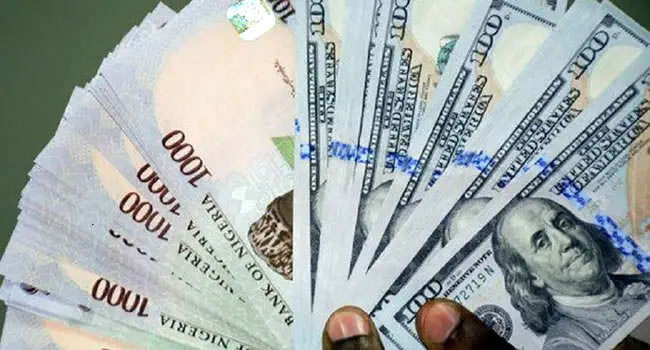
* Banks get CBN nod to sale at market determined rate
* FX rate liberalisation will boost economy, attract FDI= experts
* BDC operators fear business, job losses
The local currency, the Naira may hit the N800 exchange rate mark per United States Dollar this weekend following the liberalisation of the foreign exchange market by the Central Bank of Nigeria (CBN)
The liberalisation has seen the harmonisation of official and parallel market rates which had been operating differently for over a decade now.
On Wednesday, the apex market officially floated its naira currency after years of sticking with a hard peg that affected investors and whittled down dollar availability in the country.
The development means buyers and sellers of foreign currency in the official FX market are now allowed to quote rates they find comfortable in the FX market, as against previous practice where rates were dictated by the Central Bank of Nigeria (CBN).
The Investors & Exporters (I&E) window is now quoting a range of between N750 and N755/$, according to customers who cited emails received from their banks.
That implies a 21 percent decline in the naira compared to the previous rate of N463/$ which the Central Bank of Nigeria (CBN) is still quoting as the I&E rate on its website. However, the last time the CBN updated the rate was June 9.
Although the Central Bank of Nigeria (CBN) has not made any official statement on the authorization at the time of filing this report, feelers from sources at the apex bank and the FX market space suggested that the deposit money banks (DMBs) and other FX dealers had been briefed of the monetary policy measure.
This implies that buyers and sellers of foreign currencies in the official FX market can now quote rates they considered reasonable for their efforts in terms of returns in the FX market, as opposed to the old regime in which the apex bank dictated rates.
The development, which many investment experts see as desirable for the nation’s economy, is coming barely 9 days after President Bola Tinubu pledged, during his inaugural address, to end the multiple FX rates of the national currency – the Naira – and by doing so ensure exchange rate stability for the local currency.
Efforts by our correspondent to confirm if the apex bank actually gave the directive from the Director, Corporate Communications Department of the CBN, Dr. Isa AbdulMumin, did not yield the desired results as his phone line was inaccessible, just as some FX traders in the FCT could not actually confirm the validity of the information.
It is expected that a confirmation of the purported directive to the DMBs may be later today when data from the FMDQ is available.
Meanwhile, the Centre for the Promotion of Private Enterprise (CPPE) has described the monetary policy measure as a bold step by the President Tinubu administration to officially float the naira and allow market forces to determine the exchange rate.
The Director/CEO of the Centre, Dr. Muda Yusuf, in a statement issued on Wednesday, pointed out that the unification of the Naira exchange rate would unlock the huge potential for investment, jobs, and capital flows.
According to the foremost economist, the new FX regime will allow for flexible rate adjustments making the market predictable, equitable, transparent, and sustainable as well as reduce uncertainty and inspire the confidence of investors in the FX market.
“A unified exchange rate regime enhances liquidity and reduces uncertainty in the foreign exchange market. It would boost government revenue by a minimum of N4 trillion through additional remittance of exchange rate surplus to the federation account by the CBN and allow the use of naira cards for limited international transactions.
“It would facilitate the mopping up of naira liquidity in the economy in the short to medium term. This would positively impact the inflation outlook.
“The CPPE also expects the new policy to deepen the autonomous foreign exchange market through the liberalisation of inflows from Export Proceeds, Diaspora Remittances, Multinational oil companies, diplomatic missions, etc.”, Yusuf added.
Market analysts predict that the exchange rate could go as high as N800 before the weekend. They said an initial knee-jerk reaction could cause the naira to weaken sharply before recovering some lost ground.
“In view of the fact that this new rate in the official market is the same as the parallel market, there is no incentive for people and businesses with genuine transactions to patronize the parallel market, hence FX trading activity in the parallel market will slow down significantly,” Abiola Rasaq, an economist and former head of investor relations at United Bank for Africa.
“Subsequently, the official market should attract more FX supply and rate should gradually ease in the I&E window, and such would cause rates in the parallel market to also ease,” he stated.
The CBN’s next move should be to prioritise supply of dollars to support the naira float.
According to a source, “The convergence of the rates is only the first step, the next step is the most crucial and that is to boost supply into the market,”
“No foreign investor will come without a hedge and that can only come when there is assurance of supply. That’s the hard work,” the source said.
James Eke, a senior treasury officer with a commercial bank, was of the view that allowing the market to determine the FX rate is only the first of six steps to fixing Nigeria’s broken FX market.
The second step must be to provide a hedge mechanism that is priced in line with the market while the third step is to ensure market yields are attractive to Foreign Portfolio Investors (FPI).
The next steps are to ensure transparency and remove all controls around domiciliary accounts. Finally, there is also a need to clear the dollar backlog in the market in order to attract FPIs.
“The focus is on supply,” the source said.
Expectations are high after the initial move to fix Nigeria’s broken FX market.
Chidi Uzo, a fund manager at Stanbic IBTC Pension Managers Ltd, said the move was “a bold step in the right direction.”
“However, this should go in tandem with the lifting of capital restrictions for investors waiting on the sidelines to repatriate their funds. We expect foreign investor participation to be swayed by the extent to which capital is allowed to flow freely,” Eke said.
Above all, financial experts were of the view that the effective harmonisation of Nigeria’s multiple exchange rates by allowing market forces to determine the fair value of the naira should immediately reverse the multi-year widening spreads between the official exchange rate and the parallel market rate.



