

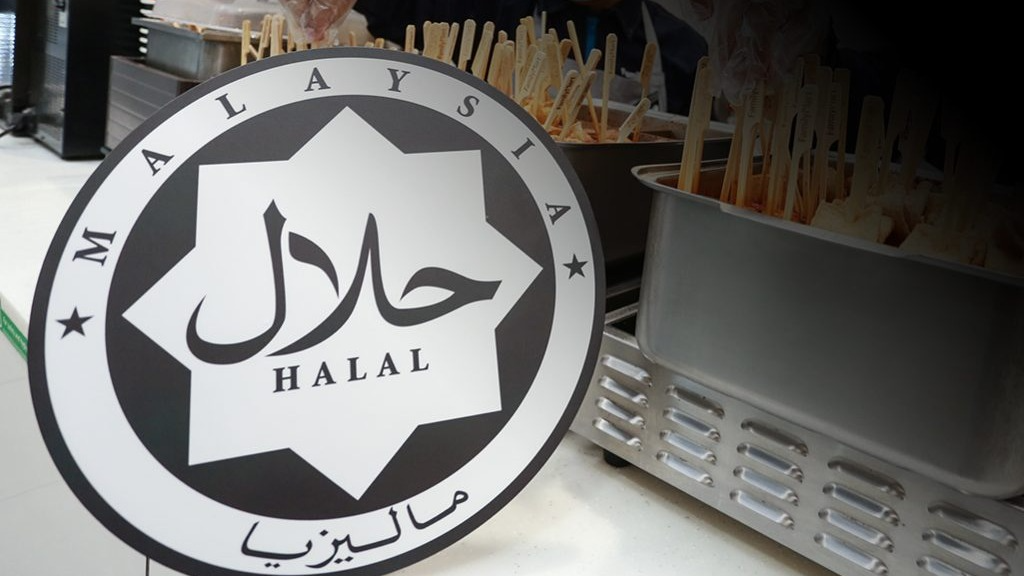
Today Monday October 27, 2025, the Federal Government will officially launch the Nigeria National Halal Economy inside the State House Banquet Hall, Aso Rock Villa.
The ceremony will be presided over by the duo of President Bola Ahmed Tinubu and Vice President Kashim Shettima.
We note that since 2023, Nigeria has been sinking deeper into the category of countries embracing Islamic practices such as Malaysia, Indonesia, United Arab Emirates, etc.
Instructively, Islamic finance has been upbeat through Sukuk, (Islamic bonds), Takaful. Also, Islamic banking has grown exponentially with the promotion of interest free services, thereby providing an alternative to conventional finance for millions of Nigerians.
Undoubtedly, Sukuk has helped in financing road reconstruction in many states and such projects are duly designated for road users to see.
But the big one is what will be officially launched today, meaning that Nigeria has fully embraced the Halal Economy.
AI simply defines Halal Economy as “an economic system that operates according to Islamic principles, encompassing all sectors from food and finance to fashion and tourism. It is defined by ethical and transparent business practices, prohibiting transactions based on interest and avoiding involvement with forbidden products like alcohol and pork.
“The system emphasizes universal values like cleanliness, social responsibility, and ethical investment, and is rapidly growing with increasing demand from both Muslim and non-Muslim consumers.”
According to AI, the key features of Halal Economy include:
Permissible by Islamic Law: The core principle is that all economic activities and products must be “halal,” or permissible, under Islamic law (Shariah).
Ethical and socially responsible: It goes beyond simple permissibility to promote fairness, transparency, and social justice. This includes environmental stewardship and human rights.
Prohibition of forbidden elements: It forbids transactions based on interest (riba) and involvement in industries or products deemed haram (forbidden), such as alcohol, pork, and gambling.
Focus on genuine value and investment: Investments are based on profit and loss sharing, rather than interest-based returns. It encourages investment in businesses that contribute to society and avoid undue harm.
We call for caution in the full adoption of the Halal Economy, given many of the grey areas. While it is indisputable that Nigeria has a large Muslim population, it is not yet an Islamic country.
There are many large populations of Christians, African Traditional belief practitioners, etc. Lumping everyone into this economy will not augur well for a troubled country like Nigeria.
We also note that over the years, many states in the northern part of the country have experimented with the Shariah Islamic law and its forbidden practices, especially alcohol consumption.
Millions of alcohol products worth billions of naira have been destroyed in states like Kano, Niger, Zamfara, Jigawa, etc. Yet, such states took and still take the lion share of VAT generated from states where alcohol is consumed.
While the Nigeria Halal Economy is touted as capable of generating $1 trillion, the benefit may pale into insignificance when trouble erupts in non-Muslim dominated states.
On October 16, 2022, Hindu Bureau warned India that the concept of halal which was earlier restricted only to meat eaten by the Muslim community had extended to a variety of sectors, including food products, consumer goods and others, posing a threat to the Indian economy.
In the past five years, there have been concerted efforts to draw Nigeria into the Islamic economy. The country’s domestic halal market was estimated to be $107 billion in 2022.
The Federal Government has actively promoted the sector through initiatives like a recent cooperation agreement with Saudi Arabia to boost investment, technical cooperation, and market access.
Nigeria’s aim was to become a leading hub for halal products and services, attracting foreign investment, creating jobs, and diversifying its economy by leveraging the global halal market, which is valued at over $7.7 trillion.
But there are many challenges which we believe that the government might not have fully or properly addressed. Among these are lack of standardized certification processes, limited business awareness, and insufficient infrastructure for production and distribution and finally access to non-Muslim markets.
Thus, we call for deeper reflections on a blatant adoption of the halal economy.
“Nigeria’s aim was to become a leading hub for halal products and services, attracting foreign investment, creating jobs, and diversifying its economy by leveraging the global halal market, which is valued at over $7.7 trillion.”



