By Joy Onu
Nigeria has launched a decisive initiative to tackle neurological disorders by establishing its first-ever Brain Health Desk and creating a National Brain Health Agenda.
For years, brain health has remained one of the least discussed aspects of healthcare in Nigeria, often attracting attention only when tragedy strikes, a stroke leaves someone unable to speak, epilepsy disrupts a young person’s education, or dementia slowly steals away cherished memories. Health experts say that silence has come at a huge cost.
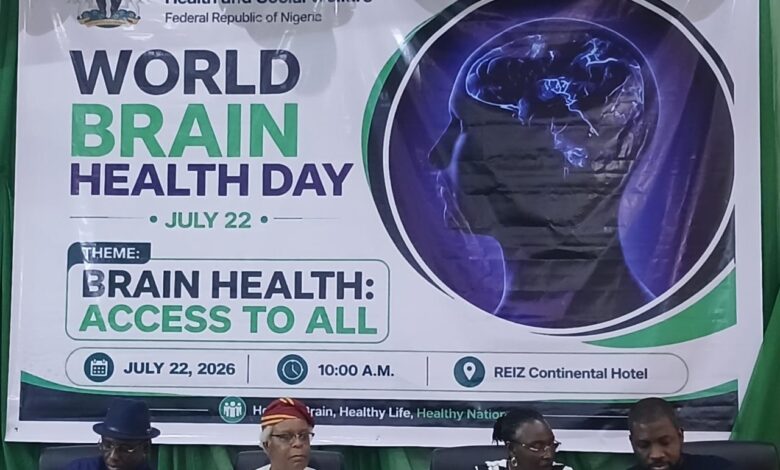
Announcing the plan on July 22, 2026, during the country’s first national commemoration of World Brain Day in Abuja, the Federal Ministry of Health and Social Welfare targeted severe deficits in national brain healthcare.
Now, the Federal Government is taking what experts describe as a significant step towards changing the narrative.
At the commemoration of World Brain Day 2026 in Abuja recently, the Federal Ministry of Health and Social Welfare announced plans to establish a Brain Health Desk under the National Mental Health Programme and develop Nigeria’s first National Brain Health Agenda, a policy expected to strengthen prevention, diagnosis, treatment and long-term care for neurological disorders.
The announcement comes as health authorities warn that neurological diseases are becoming a growing public health challenge in Nigeria, driven by rising cases of stroke, epilepsy, dementia, Parkinson’s disease, traumatic brain injuries and other disorders affecting millions of people.
Declaring the event open, the Permanent Secretary of the Federal Ministry of Health and Social Welfare, Ms. Daju Kachollom, said brain health deserves the same national attention as other major health priorities because it directly influences learning, productivity, healthy ageing and economic development.
According to her, access to quality brain health services should not depend on where a person lives or how much they earn.
“Brain health is a critical pillar of Universal Health Coverage. Every Nigerian, irrespective of age, gender, income or location, deserves access to quality brain health services.”
She said that neurological disorders now affect more than 3.4 billion people globally, making them the leading cause of disability worldwide.
“Our country continues to experience a growing burden from stroke, epilepsy, dementia, Parkinson’s disease, traumatic brain injuries and neurodevelopmental disorders, many of which are further complicated by mental health conditions such as depression and anxiety.”
For Kachollom, the establishment of the Brain Health Desk represents more than another government office.
She explained that the unit will coordinate policy development, strengthen surveillance systems, promote research, build workforce capacity and bring together government agencies, universities, teaching hospitals, professional associations, development partners and civil society organisations to improve neurological care nationwide.
The proposed National Brain Health Agenda, she said, will provide a roadmap for expanding access to specialist services while aligning Nigeria’s efforts with the World Health Organization’s Intersectoral Global Action Plan on Epilepsy and Other Neurological Disorders (2022–2031).
“The Brain Health Desk represents a major milestone in strengthening national leadership and coordination on brain health.”
She stressed that investment in brain health extends beyond healthcare.
“Investing in brain health is not only a health imperative; it is an economic imperative. By protecting brain health across the life course, we unlock human potential, strengthen productivity, foster innovation and lay the foundation for a thriving brain economy.”
Her remarks echoed growing global concern that neurological disorders are increasingly undermining economic productivity, educational attainment and family wellbeing, particularly in low- and middle-income countries where specialist services remain limited.
Brain health experts say many neurological conditions are either preventable or can be effectively managed when detected early. Lifestyle choices such as controlling blood pressure and diabetes, eating nutritious meals, exercising regularly, avoiding tobacco, limiting harmful alcohol consumption, preventing head injuries and seeking prompt treatment for infections all play an important role in protecting the brain throughout life.
Yet awareness remains low. Many Nigerians still attribute seizures or behavioural changes to spiritual causes, while symptoms such as memory loss, persistent headaches or slurred speech are frequently ignored until irreversible damage has occurred.
A consultant neurologist, who requested anonymity, said delayed presentation remains one of the greatest obstacles to successful treatment of neurological disorders in Nigeria.
“One of our biggest challenges is that many patients arrive at the hospital too late. Conditions like stroke have a narrow treatment window, and every minute counts. Early recognition and prompt medical attention can significantly improve recovery.”
The neurologist said prevention should begin long before symptoms appear.
“Brain health begins long before someone develops a neurological disorder. Controlling blood pressure, diabetes and cholesterol, exercising regularly and avoiding tobacco are some of the most effective ways to reduce the risk of stroke and other brain diseases.”
He added that many neurological conditions can be successfully managed when patients seek help promptly.
“Many neurological conditions are treatable or manageable. Unfortunately, myths, stigma and poor access to specialist care continue to delay diagnosis in many communities.”
Director of Public Health at the Ministry, Dr. Charles Nzelu, said reversing that trend requires sustained public education alongside stronger healthcare services.
Speaking during the event, he described brain health as fundamental to individual wellbeing and national development.
“Brain health is essential for learning, productivity, healthy ageing, social participation and national development.” He warned that neurological disorders have emerged as one of the world’s greatest public health challenges, with stroke remaining a leading cause of illness, death and long-term disability in Nigeria.
According to him, the annual World Brain Day celebration provides an opportunity to deepen awareness, strengthen partnerships and mobilise practical solutions to reduce the country’s neurological disease burden.
“Every Nigerian, irrespective of age, gender, socioeconomic status or geographical location, deserves equitable access to quality brain health services.”
The growing burden of neurological disorders is reflected not only in hospital statistics but also in the experiences of patients whose lives have been permanently altered by diseases that experts say are often preventable or manageable when detected early.
One of such survivors, Ahmed Olarinwaju, recalled how he mistook the warning signs of stroke for ordinary stress until it was almost too late.
“I thought it was just stress when my arm became weak and my speech started to slur. By the time I got to the hospital, doctors said I should have come much earlier.”
Although recovery has been gradual, he said determination, physiotherapy and family support have helped him regain confidence.
“Recovery has been slow, but physiotherapy and family support have helped me regain confidence. I now tell everyone not to ignore the warning signs.”
For Olarinwaju, surviving the illness also changed his understanding of impact on families.
“A stroke doesn’t only affect the patient. It changes the lives of everyone in the family,” he said.
Picking up from the experiences of survivors, caregivers say neurological disorders often leave invisible scars that extend far beyond the patient.
For Emmanuel Ebu, caring for his father after a stroke has become a daily responsibility that has tested the family’s emotional resilience and financial capacity.
“Looking after my father after his stroke has been emotionally and financially demanding. Someone has to be with him almost all the time.”
According to him, the burden on caregivers is often overlooked despite the sacrifices they make to support recovery.
“Many caregivers need counselling and financial support because brain disorders affect the whole household, not just the person living with the illness,” Ebu said.
His experience reflects the reality facing many Nigerian families who struggle to cope with the long-term costs of rehabilitation, medication, transportation and lost income following neurological illnesses.
For people living with epilepsy, the battle does not always end when seizures are brought under control.
An Abuja resident and epilepsy survivor, Adams David, told New National Star that society’s perception of the condition remains one of the biggest obstacles to living a normal life.
“Living with epilepsy has been harder because of stigma than because of the seizures themselves. Many people still misunderstand the condition.”
He said access to proper treatment had enabled him to rebuild his life despite years of misconceptions surrounding the disease.
“With proper medication and regular medical care, I have been able to continue working and living a productive life.”
Medical specialists believe cases like these underscore the urgent need to strengthen Nigeria’s neurological care system.
A neurosurgeon and neurologist, who also requested anonymity, attributed the increasing number of neurological cases to a combination of preventable health conditions and injuries.
“We are seeing more cases linked to uncontrolled hypertension, diabetes and traumatic brain injuries. Prevention must become a national priority.”
The specialist observed that access to expert care remains uneven across the country.
“Specialist neurological services are still concentrated in major cities. Many patients travel long distances before receiving appropriate care.”
Public health experts argue that investing in brain health should no longer be viewed solely as a healthcare issue but as an investment in national development.
A public health expert, Ejiro, who works in one of the government hospitals in North Central Nigeria, said neurological disorders have far-reaching consequences for education, employment and economic productivity.
“Brain health is no longer just a medical issue. It affects education, productivity, employment and national development.” He stressed that prevention remains the most cost-effective strategy.
“Investing in prevention is far less expensive than managing lifelong disability caused by preventable neurological diseases.”