

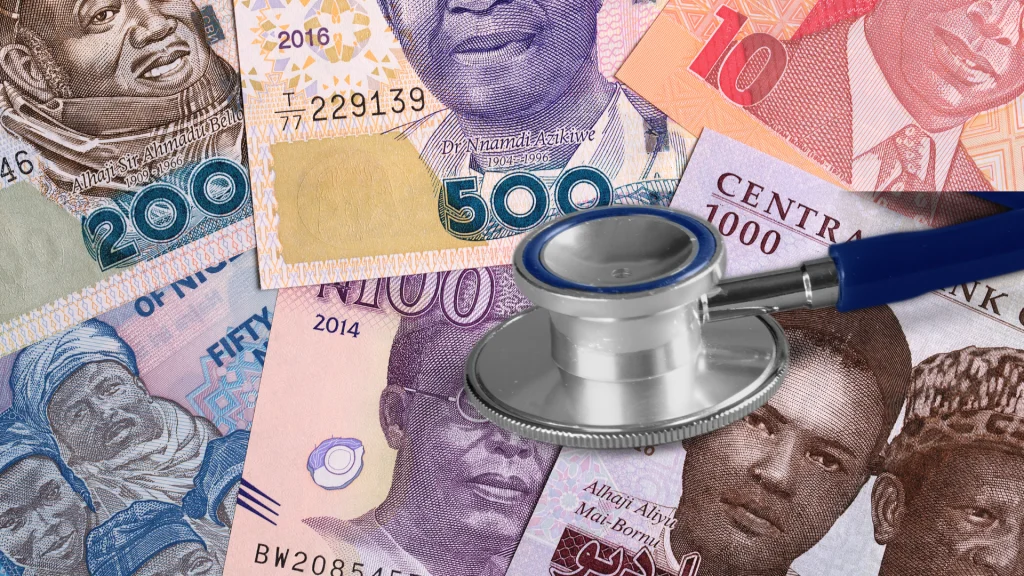
In the last five years, healthcare costs have risen astronomically. Today, most families can hardly afford good treatment in the hospitals.
Healthcare costs are believed to have increased in the past by between 15 percent and 20 percent annually over the past five years, thus consuming almost 10 percent of household incomes.
And budget provisions are never commensurate with the people’s needs. The 2025 Appropriation Bill presented by President Bola Ahmed Tinubu, for instance, showed that Healthcare accounts for only 5.15 percent of the total budget, significantly below the Abuja Declaration target of 15 percent.
Although healthcare funding increased by 58.53 percent from ₦1.62 trillion in 2024 to ₦2.56 trillion in 2025, per capita spending only increased from ₦7,395 ($9.2) in 2024 to ₦11,724 ($7.8) in 2025. This is critically low, about ₦33 ($0.02) per day.
A breakdown showed that routine immunization funding increased by 17.56 percent from ₦211.72 billion in 2024 to ₦249.54 billion in 2025.
Family planning funding was slashed by 97 percent from ₦2.23 billion in 2024 to ₦66.39 million in 2025, with no provision for contraceptive procurement.
The total budget of the National Primary Health Care Development Agency, NPHCDA, decreased by 29.27%, with capital budget allocations reduced by 33.8 percent in 2025.
National Health Insurance, NHIS, funding increased overall by 74.07 percent due to growth in Basic Healthcare Provision Fund (126.94%) and MDAs allocations (52.79%), but its core budget was reduced by 25.36%.
Noteworthy is the fact that in 2023, only 26.99 percent of the Federal Ministry of Health’s capital budget was released, and just 17.29 percent of the allocated funds were utilized.
With a population of about 200 million, Nigerians daily face formidable challenges in accessing quality healthcare. By March 2024, Nigeria’s general hospitals were understaffed, with only 55,000 licensed doctors to serve the population.
Because public health institutions lack basic amenities and workforce necessary for quality care, patients are now regularly referred to private hospitals where diagnostic services are very expensive.
For instance, the typical MRI costs between ₦150,000 and N250,000; CT scan, ₦80,000; Blood work, between ₦25,000 and ₦45,000; Ambulance services from ₦25,000 to ₦100,000 and ICU care, between ₦200,000 and ₦500,000 per day.
Experts have noted that Nigeria’s healthcare system is fraught with “high out-of-pocket expenditures, which account for approximately 74.68 percent of total healthcare funding—significantly above the regional average.”
Furthermore, they noted that neonatal mortality remains alarmingly high at 41 deaths per 1,000 live births as of 2023, while maternal mortality rate is among the worst globally, standing at 576 deaths per 100,000 live births.
We believe that the government at all levels should devote more attention to the health sector through increased budget provisions and improved facilities.
They must strengthen primary healthcare services, expand immunization programmes and improve maternal and child health.
Above all, the governments must address the perennial manpower shortages through frontal attack against brain drain in the medical profession; just as there should be investments in capacity building and retention initiatives.
“…the governments must address the perennial manpower shortages through frontal attack against brain drain in the medical profession; just as there should be investments in capacity building and retention initiatives.”



