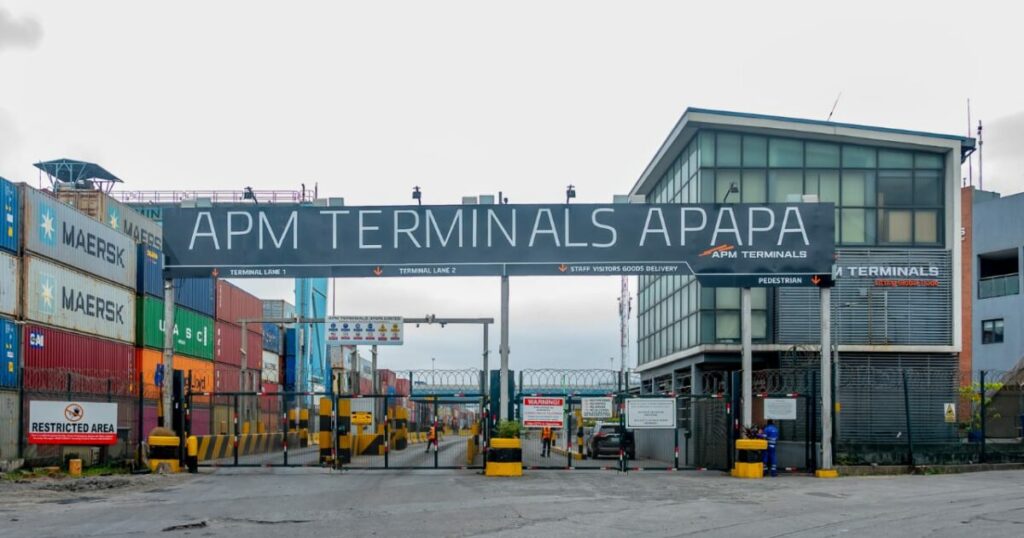
Nigeria’s next phase of port concessions must reflect changing industry realities, provide regulatory certainty and accommodate emerging investment needs to sustain private-sector investment in the maritime sector, APM Terminals Apapa has said.
The company warned that concession terms that fail to reflect changes in vessel sizes, technology, operating costs and global trade patterns could undermine long-term investments and weaken the competitiveness of Nigerian ports.
The Government Relations Manager of APM Terminals Apapa, Olayinka Akinlade, stated this at the 17th Annual General Meeting of the Nigeria Maritime Lawyers Association (NMLA), held in Lagos.
Speaking during a panel discussion titled, “Port Concessions 2.0: Economic Regulation, Private Capital and the Next Phase of Nigerian Port Development,” Akinlade said nearly two decades of port concession experience had demonstrated the importance of contractual clarity, regulatory predictability and long-term investment certainty.
According to her, the next generation of concession agreements must provide clearly defined responsibilities for both the government and private operators, backed by appropriate tenure arrangements and a predictable regulatory environment.
“The first lesson is that port concessions are long-term partnerships and require the certainty necessary to support long-term investment. The responsibilities of the grantor and concessionaire must therefore be clearly defined and supported by appropriate tenure, contractual certainty and a predictable regulatory environment,” she said.
Akinlade noted that the operating environment had changed significantly since the commencement of Nigeria’s port concession programme in 2005, making it necessary to review the terms guiding the next phase of the arrangement.
“Second, concession terms must reflect today’s realities while anticipating tomorrow’s needs. The operating environment has changed significantly since 2005. Vessel sizes, technology, cost structures, trade patterns and regional competition have all evolved. Concessions 2.0 must therefore be sufficiently forward-looking and flexible to accommodate these changes and enable future investment,” she said.
She stressed that private terminal operators also had a responsibility to translate investment certainty into measurable improvements in port operations through modern infrastructure, technology adoption, increased capacity and operational efficiency.
For APM Terminals Nigeria, she said this would involve sustained investments in infrastructure and technology, improved operational capacity and efficiency, as well as the application of global expertise in collaboration with government and other industry stakeholders.
However, she said the government must complement private-sector investments by providing policy and regulatory certainty and developing critical supporting infrastructure, including marine facilities, access roads, rail connectivity and reliable electricity.
“Government, on the other hand, has a critical role in providing not only the policy/regulatory certainty but also ensuring that critical enabling infrastructure, such as marine infrastructure, access roads, effective rail connectivity and reliable power supply, develops alongside private-sector investment,” she added.
According to her, the success of the next phase of port concessions should be assessed beyond the volume of investments made within terminals to include their impact on cargo movement, trade capacity, competitiveness and the overall cost of doing business in Nigeria.
“Over the next decade, the success of the concession model should ultimately be measured not only by investment within the terminals, but also by its impact on cargo flow, trade capacity, competitiveness and the overall cost of doing business in Nigeria,” she said.
Earlier, Professor Adi Bongo of the Lagos Business School, in his keynote address titled, “Nigeria’s Maritime Paradox: From Maritime Potential to Global Competitiveness,” identified bankability as a major factor limiting the ability of the maritime sector to attract investments.
Bongo argued that bankability should not be treated exclusively as a financial or banking issue, noting that the strength and enforceability of legal agreements were equally important in determining investors’ confidence.
He said lenders and investors needed assurance that contractual rights and security arrangements could be enforced through a predictable legal system.
“For lenders, the key question is not simply what the rules say, but how effectively the courts apply them. At present, we cannot answer that question with sufficient data. A ship is one of the most mobile forms of collateral, and lenders will price a Nigerian ship mortgage based on the speed of the slowest court likely to handle it, not the fastest,” he said.
He stated that lenders required measurable evidence that maritime laws could be enforced within predictable timelines, warning that the absence of such evidence could affect the pricing of maritime investments.
Bongo consequently urged the NMLA to develop and publish its first Lagos Maritime Justice and Competitiveness Scorecard by its 18th AGM in November 2027.
He said the proposed scorecard would provide measurable evidence of the efficiency and predictability of maritime dispute resolution, helping to strengthen investor confidence in Nigeria’s maritime industry.
He also challenged members of the maritime legal community to recognise their role in improving the country’s competitiveness through effective legal documentation, enforceable security arrangements and efficient dispute resolution.