BY ODIGIE OKPATAKU
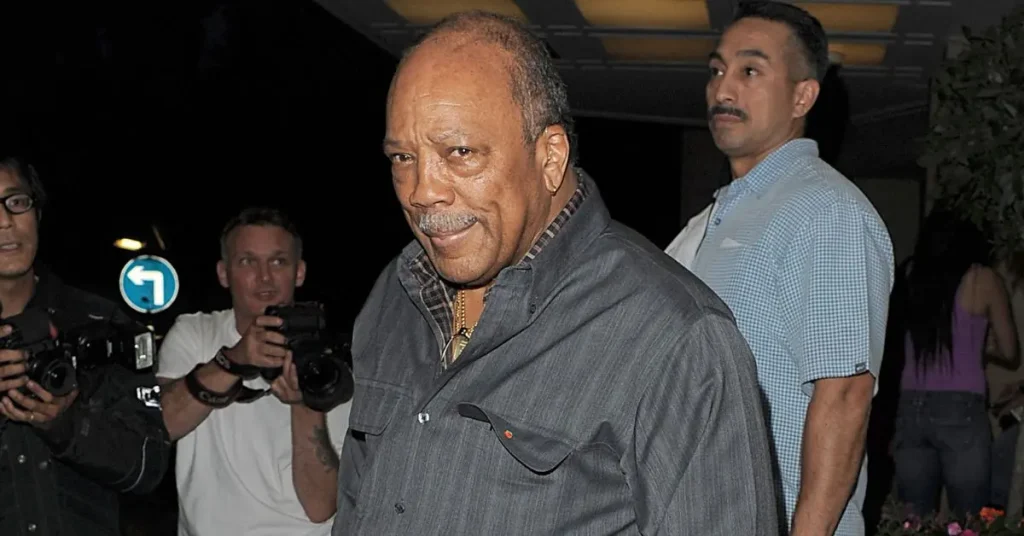
The late music icon Quincy Jones’ dream estate is now up for grabs—for a cool $60 million.
Jones designed the 25,000 sq. ft. mansion, inspired by South Africa’s Palace of the Lost City.
Daughter Rashida Jones said, “We hope the new owner continues the legacy of love, laughter, and beauty.”
Hollywood director, James Foley dies @71
Hollywood has dimmed its lights for one of its own.
James Foley, the seasoned and sharp-eyed director best known to mainstream audiences for Fifty Shades Darker and Fifty Shades Freed, has died at the age of 71 after a private battle with illness. The news was confirmed by close family sources, marking the end of an era for a filmmaker whose camera captured both the sensual and the stark.
Foley’s career, spanning more than four decades, was a study in range and quiet resilience. Long before he entered the billion-dollar universe of the Fifty Shades franchise, he made his name with gritty, character-driven stories like At Close Range (1986), starring Sean Penn and Christopher Walken — a haunting tale of loyalty, betrayal, and familial dysfunction that critics hailed as a raw gem. But it was Glengarry Glen Ross (1992), adapted from David Mamet’s Pulitzer-winning play, that etched his name into the annals of American cinema. The film’s rapid-fire dialogue and electric performances — especially Alec Baldwin’s “Always Be Closing” monologue — have since become pop culture legend.
Foley was a director’s director — not flashy, but focused; not loud, but exacting. Whether navigating the psychological terrain of a crime thriller or the emotionally tangled web of romance, he brought an eye for mood, a hand for pacing, and a gift for letting actors breathe. Over the years, he worked with Al Pacino, Madonna, Mark Wahlberg, and Reese Witherspoon, always drawing out textured, layered performances.
Born in Brooklyn, New York, in 1953, Foley studied filmmaking at the University of Southern California and rose through the industry ranks with quiet tenacity. His earliest work, including 1984’s Reckless and Madonna’s Live to Tell music video, showed a flair for both cinematic style and emotional intimacy.
Though the Fifty Shades films were polarizing, they introduced Foley’s name to a new generation and showcased his ability to handle big-budget studio pressure while maintaining a cohesive visual language. Love them or loathe them, the films were global hits — and Foley delivered them with polish.
James Foley leaves behind a legacy not defined by a single genre, but by a constant — the pursuit of truth on screen, however uncomfortable or unconventional. He is survived by family, friends, and a body of work that, like all great cinema, invites us to watch again — and see more the second time.