

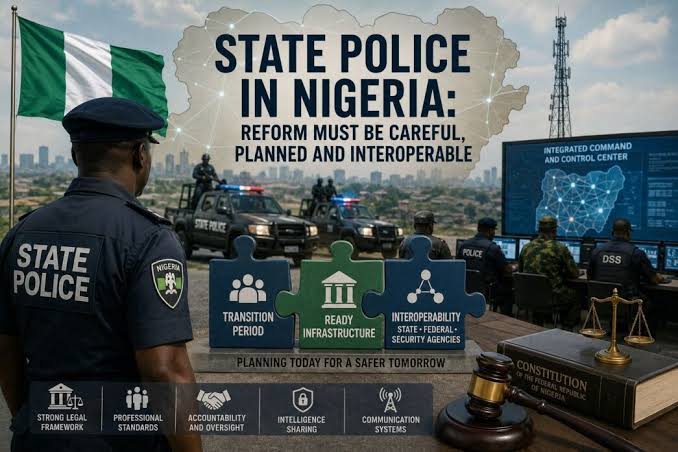
Recently, President Bola Tinubu, in furtherance of his resolve to entrench federalism and provide security to the nooks and crannies of Nigeria, appealed to the President of the Senate, Godswill Akpabio, and his House of Representatives counterpart, Rt. Hon. Tajudeen Abas, to hasten the establishment of the State Police in Nigeria. The President made the call after he sent a delegation led by his Chief of Staff, Rt. Hon. Femi Gbajabiamila to Oyo State, following the widely-publicised kidnap of schoolchildren and their teachers. There is no doubt that if the State Police is actualised, it will definitely be to the credit of the Tinubu administration, and Nigerians will be the better for it.
The core essence of the State Police is using the citizens of a state to provide security services for the state. As it is widely said that politics is local, the current administration wants to also localise security of lives and property. No past administration has ever pushed for the restructuring of the Nigeria Police Force more than the current Federal Government. At first, many opinion moulders and political analysts had argued that it would be an exercise in futility as past administrations attempted to restructure and decentralise the policing system but to no avail. But give it to President Tinubu, he has the knack for galvanising the people. He rallied the ruling All Progressives Congress (APC) and the opposition parties’ governors to be on the same page with him so as to restructure the policing system. He did it to the admiration of a vast majority of Nigerians, and he even convinced the principal officers of the National Assembly to key into his vision.
The insecurity in Oyo State was the catalyst for the debate yet again among the Civil societies, NGOs and various groups, all calling for the establishment of the State Police. The NASS has deliberated on the State Police Establishment Bill, with the House Representatives making tangible progress with the Constitution of the Federal Republic of Nigeria (Alteration) Bill seeking to amend Section 214 of the 1999 Constitution to decentralise the nation’s security architecture to create a dual policing structure of Federal Police and State Police.
Section 214 will be amended to formally recognise and provide for the coexistence of Federal and State Police. It also moves policing authority from the Exclusive to the Concurrent Legislative List. A new Section 215 will delineate leadership and command, outlining the structure of the Federal Police and granting state authorities management control over their respective state police forces; while a new Section 216 establishes guidelines for the funding support and administration of the respective police formations.
The Third Schedule will be amended to reconfigure the old Nigeria Police Council and establish distinct State Police Service Commissions to oversee recruitment, discipline and operations.
The bill has successfully passed the second reading and voting stages in the House of Representatives. It is currently undergoing further legislative reviews and deliberations in the Senate. Once passed by both chambers of the National Assembly, it will require presidential assent and ratification by two-thirds (24) of the 36 State Houses of Assembly to be domesticated.
It is also in the news that over 95 per cent of the state governors, state legislators have agreed on the establishment of the State Police. Also, state attorneys-general are going through the Bill to produce a well-made law for the newest policing system.
However, in as much as we need the State Police and restructuring of the entire policing architecture, the National and State Assemblies should as a matter of patriotism make robust and clear-cut laws for State Police to stand out from the usual Federal Policing encumbrances that affected the smooth operations of police personnel in maintaining law and order. There should be adequate legislation on the issue of poor welfare and remuneration packages, inadequate police barracks, logistics for patrolling and surveillance. Also, progression, recruitment, promotion and retirement of officers should be spelt out in the State Police Act. Punishment over unprofessional conducts should be boldly stated.
It is pertinent to remind the lawmakers of the importance of the recruitment of the highest ranking State Police officer – the Commissioner of Police, extricating that role from the State Governors and let it come from the highest ranking and most qualified officers as is the case in the judiciary, where heads of the courts are chosen from the highest ranking officers. If the governor did not influence the appointment or promotion of the State Police commissioner, he or she should not be in the position to fire the commissioner. Also, the new law should specify the supervisory authority over the State Police officers. This will give the State Police enough leverage to function properly.
It was commendable the Nigeria Governors Forum at its recent meeting demanded constitutional guardrails before accepting the State Police. This simply implies a structural mechanism, law, or norm designed to prevent the abuse of power, protect minority rights, and ensure no single branch of government becomes too dominant. These boundaries are meant to protect democracy from devolving into authoritarianism.
According to the communique, rising from their gathering last Wednesday, read by the Forums Chairman, Gov AbdulRahman AbdulRazaq of Kwara State, the Forum stated emphatically that the State Police arrangement must be constitutionally sound, consistent with the principles of federalism and protective of citizens’ rights. It was from the communique Nigerians learnt that the Forum has held a dedicated consultation with the States Attorneys-General to review constitutional amendments and operational framework of the State police.
This is resoundingly commendable, especially coming from the class of people the citizens fear that may hijack the State Police and use it against perceived political enemies; but they now insisting that it should be bound by laws. We aware that majority of Nigerians want the State Police system to succeed as they wouldn’t in any way wish a repeat of the characters, actions of the Federal Police in the new State Police system.
The EndSARS protest in Lagos and other cities on October 20, 2020 was about restructuring the Federal Police entirely. Nigerians, especially the youth couldn’t stomach the behaviour and operational patterns of some Police officers. The system was in total mess and required overhaul and rebirth. But the youth were disappointed, even though the SARS was renamed and fragmented, their characters and modus operandi have remained the same.
The New National Star is not averse to making a quick law for the establishment of the State Police, which aims to help curb insecurity, but we suggest that the lawmakers and all those concerned should remove any resemblance of the modus operandi of the Federal Police from the State Police. The governors should not appoint the Commissioner of Police, rather appointments within the State Police should flow progressively from the highest-ranking officers to create an independent state policing structure.



