… To finance infrastructure and development projects for 2026/2027
…Request referred to Senate C’ittee on Local and Foreign Debts
…Says over $6bn W’Bank funding mobilised to tackle poverty — FG
By Simeon Ogoegbulem
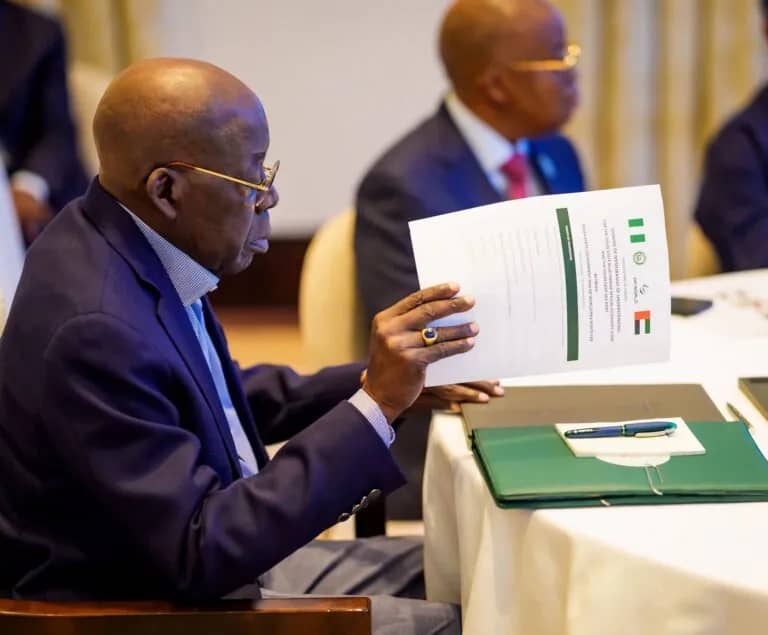
President Bola Tinubu has asked the Senate to approve the Federal Government’s 2026–2027 Supplementary External Borrowing Plan, involving $20.52 billion and €1.05 billion, to finance infrastructure and development projects across the country.
The request, which was transmitted to the National Assembly, was read by the President of the Senate, Sen. Godswill Akpabio, during Tuesday’s plenary.
In the letter, Tinubu urged the lawmakers to give the borrowing plan early consideration and approval, saying the funds would support critical projects and programmes in infrastructure, agriculture, healthcare, education, water supply, security, employment generation and financial management reforms.
The President said the external financing was necessary to address Nigeria’s infrastructure deficit and bridge the funding gap hampering the implementation of development projects.
He wrote, “I submit the attached Federal Government 2026–2027 Supplementary External Borrowing Plan for consideration and early approval of the National Assembly to ensure prompt implementation of our projects.”
Tinubu explained that the projects and programmes included in the plan had been selected following technical and economic evaluations, with emphasis on their expected contributions to the country’s socioeconomic development.
He said the initiatives were also intended to create jobs, promote skills acquisition and entrepreneurship, reduce poverty and strengthen food security.
“These initiatives aim to generate employment, promote skill acquisition, foster entrepreneurship, reduce poverty and enhance food security, all of which improve the livelihood of the Nigerian child,” he said.
According to the President, most of the projects would be implemented across the 36 states and the Federal Capital Territory, underscoring the nationwide scope of the proposed investments.
He argued that the scale of Nigeria’s infrastructure needs made additional financing necessary, while maintaining that external borrowing would help close the funding shortfall.
“In light of the need for significant infrastructure investment in the country and the vast financial resources needed to address this gap, it has become essential to pursue prudent external borrowings to close the financing shortfall,” Tinubu stated.
He added that the funds would primarily be channelled into critical infrastructure, particularly in the power, transportation and healthcare sectors.
The President urged the Senate leadership and the wider National Assembly to approve the plan promptly, arguing that timely approval would facilitate disbursements and accelerate project implementation.
However, the request is expected to undergo scrutiny by the relevant Senate committees, particularly against the backdrop of the government’s existing borrowing arrangements and the need to establish the precise scope of the proposed financing.
Reacting after the letter was read, Akpabio said the borrowing plan had featured in previous government borrowing and budgetary arrangements, although he expressed uncertainty about the exact period covered by the earlier approval.
“The borrowing plan is attached, but of course, this was even earlier approved in our budget, and also the external borrowing plan was approved as far back as 2025 to 2027, I think to 2028 or thereabout,” Akpabio said.
The Senate President said the new request would be referred to the Senate Committee on Local and Foreign Debts for consideration, with possible input from the Committees on Appropriations and Finance.
“This request will be looked at by the Committee on Local and Foreign Debts, probably in collaboration with Appropriations and Finance, but mainly by the Committee on Local and Foreign Debts,” he stated.
The committee’s review is expected to examine the details of the proposed borrowing plan and its relationship with previously approved financing arrangements before the Senate determines the next legislative steps.
The Senate’s consideration will be a key step in determining whether the proposed external financing receives the necessary legislative approval.
The New National Star reports that documents from the Debt Management Office (DMO) showed that external debt alone has risen from $43.1 billion to $54.5 billion, indicating an increase by $11.4 billion by June 2026.
According to the data from DMO, major foreign loans approved in the last three years include a $750 million (about N1.042 trillion obtained from the World Bank. The amount is made up of $449 million drawn from the International Bank for Reconstruction and Development (IBRD) and $301 million drawn from the International Development Association (IDA).
In June, 2023, the Federal Government, yet again, approached the World Bank and accessed $500 million (about N695 billion) specifically for Women Empowerment. In July 2023, the Federal Government got another $800 million (about N1.112 trillion) from the World Bank. The loan was to fund a safety net for subsidy removal palliatives.
In September, 2023, the government obtained a $700 million (about N973 billion) for adolescent girls learning programme under its Adolescent Girls Initiative for Learning and Empowerment (AGILE) project. In December, another $750 million (about N1.042 trillion) was obtained from the Bretton Wood institutions for renewable energy scale-up.
Another loan of $1.5 billion was obtained in June 2024 for Reforms for Economic Stabilisation (RESET) project which included a $750 million technical support for poor and the vulnerable. In September, 2024, the government got another $1.57 billion for Human Capital Opportunities for Prosperity and Equity (HOPE & SPIN).
In March 2025, the government obtained yet another $1.08 billion to address education and resilience challenges. Government had also obtained a total of $4.55 billion in Eurobond facilitates. The government also approached the Africa Export Import Afrexim) Bank and obtained the sum of $3 billion loan for naira stabilisation.
The Tinubu government also approached Africa Development Bank (AfDB) and got $1 billion for various development projects.
In March 2026, the government got a $1.8 billion syndicated loan from First Abu Dhabi Bank of United Arab Emirates (UAE) including a $5billion derivatives arrangement.
According to the data from DMO, total public debt as at September, 2026, stood at $120.93 billion (about N166.79 trillion). A breakdown of the public debt profile showed that domestic accounted for N91.59 trillion, representing 54.9 per cent, while external debt overhang accounted for N75.20 trillion, representing 45.1 per cent of the total debt stock.