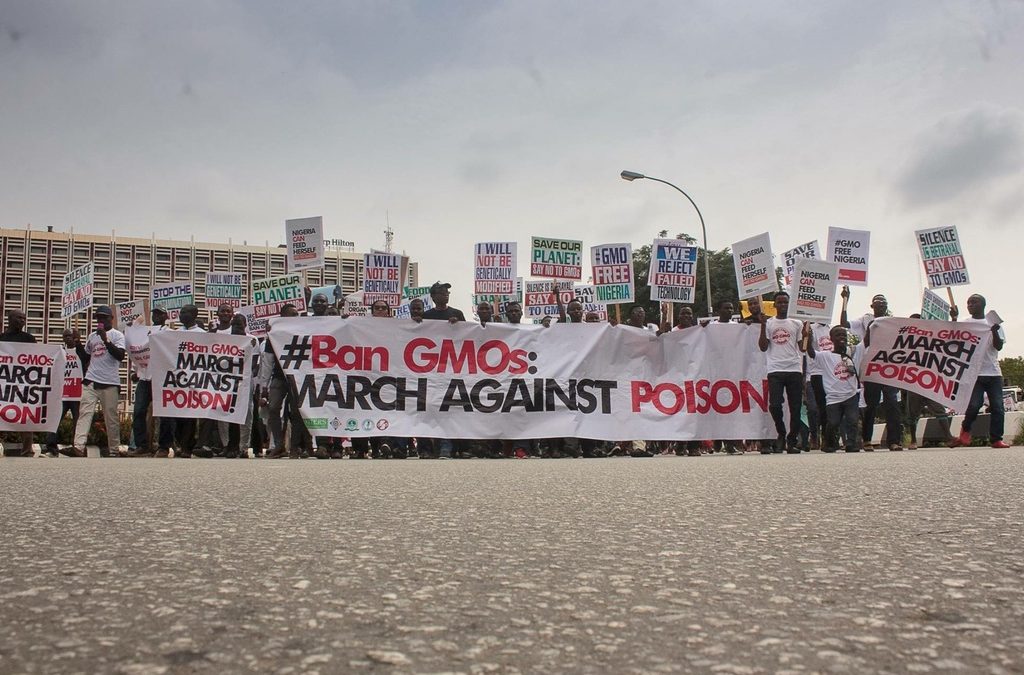
Leading Civil Society Organisations (CSOs), on Wednesday, called on the Federal Government to upgrade the moratorium on the use of Genetically Modified Organisms (GMOs) and their products in Nigeria by the National Assembly to an outright ban.
The food safety and sovereignty focused CSOs are Health of Mother Earth Foundation (HOMEF), Environmental Rights Action/Friends of the Earth Nigeria (RRA/FoEN), and the GMO-free Nigeria Alliance.
This call was made in a statement issued by HOMEF’s Media/Communication Lead, Miss Kome Odhomor, to mark World Food Safety Day 2025.
The group noted there was an urgent need for a food systems transformation in
Nigeria to ensure the availability, accessibility, and affordability of food and to ensure resilience to environmental challenges, including climate change.
They maintained that the country cannot adopt a technology whose disadvantages far outweigh potential advantages and benefit only a handful of people, the biotech corporations and their allies.
The statement quoted the Executive Director of HOMEF, Dr Nnimmo Bassey, as saying that a moratorium on GMOs by the National Assembly was very appropriate.
According to Bassey, a nullification of previous permits and approvals is critical because GMOs are designed not to address food insecurity but to consolidate control of the food and farming system in the hands of a few corporations/seed industries.
“This is known by the patent rights enforced on the products, which prohibit farmers from saving, sharing or replanting the seeds. Even those without the patent restrictions, when replanted, yield poorly.
“This is a calculated attack on Nigeria’s food sovereignty and must be seen as such. Seed saving and sharing is an age-long culture in Nigeria, where farming is about 80 per cent informal, with farmers being able to select and improve seeds using traditional methods and being able to exchange the same.
“It is worthy of note that the Cotton Farmers’ Association of Nigeria in 2024 noted that
In about three years since they were given the Bt Cotton to plant, they haven’t recorded any significant increase in yields compared to the indigenous varieties; instead, they have observed that their soils become unproductive after they planted the genetically modified cotton,” Bassey explained.
The statement also quoted a Molecular Biologist and Researcher, Dr Ifeanyi Casmir, as noting that there is no evidence of long-term risk assessment conducted on the health impact of GMOs.
He highlighted that several studies link the consumption of GMOs to diverse health disorders, including immune system disorders, increased allergic responses, chronic inflammation and organ toxicity, as well as tumour development.
Casmir also noted that studies have found Bt toxins (Cry1Ab) in 93 percent of pregnant women and 80 percent of fetal cord blood, raising risks of birth defects, cancer, and allergies.
“The fact that our regulatory agency -the National Biosafety Management Agency (NBMA) cannot show any evidence of independent and extensive risk assessment conducted shows irresponsibility and lack of concern for public health,” he said.
According to Mariann Bassey-Orovwuje, ERA’s Deputy Executive Director, Nigeria, currently does not have a policy on open market labelling and as such, the public does not have the right of choice as to whether or not to consume GMOs.
“This negates our right of choice and the right to safe food,” she said.
Orovwuje further noted that there are fundamental flaws with the current Biosafety Regulatory Agency, including that there is no provision on strict liability, which should ensure that the holder of a permit for any GM product takes responsibility for any negative effects that will ensue.
A professor of Medical Microbiology and Immunology at the Niger Delta University, Prof Tatfeng Mirabeau, also added his contribution.
“Another critical reason why Nigeria should hold the brakes on GMOs is the impact on the environment. Bt Crops, for example, the Bt beans that were approved for commercial release in 2019 and 2024, respectively, contain proteins that, when released into the soil, destroy soil microorganisms, leading to soil degradation and reduced fertility.
“There have been reported cases of pest resistance leading to the development of superbugs and superweeds in the case of the herbicide-tolerant GMOs, which make up about 80 per cent of all GMOs globally,” he added